
Oldest Stadiums in African Football History
The oldest football stadiums in Africa include venues like Ellis Park in South Africa, Stade Chedly Zouiten in Tunisia, and Cairo International Stadium in Egypt, reflecting early football development, colonial influence, and the continent’s deep-rooted sporting heritage.
SPORTS
Godha
3/30/20266 min read
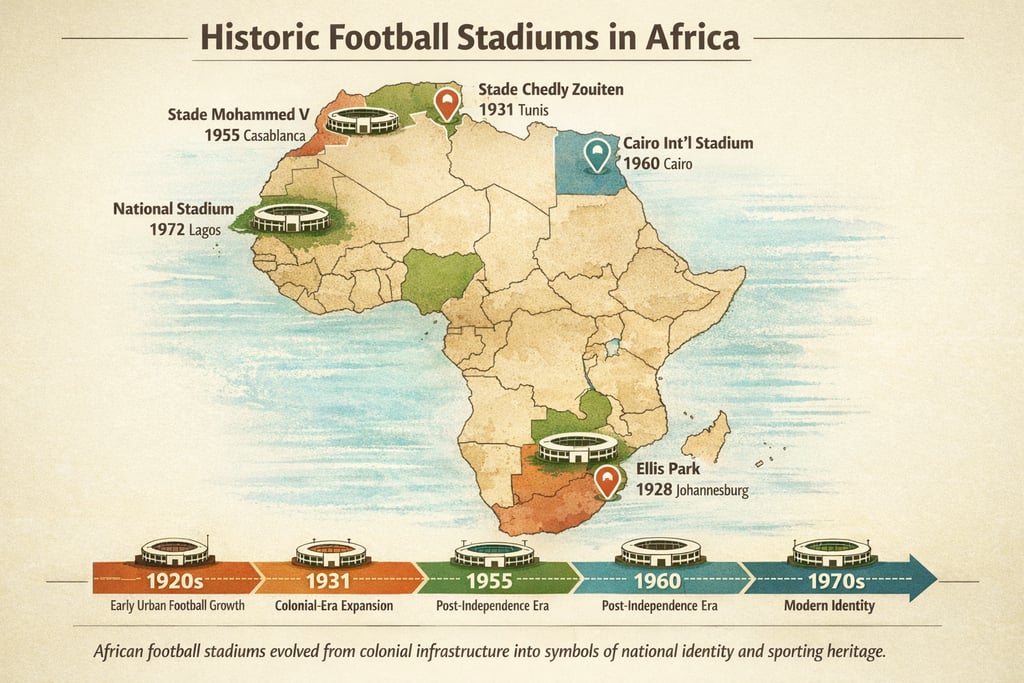
Oldest Stadiums in African Football History
I’ve always found it fascinating how stadiums carry memories. Not just matches, but eras. In Africa, some stadiums feel like living archives, where football history, politics, and culture quietly intersect.
If you want to understand African football beyond trophies and players, you need to start with its oldest stadiums. They tell the real story.
What defines the oldest stadiums in African football?
The oldest stadiums in African football are defined by their original construction dates, continuous use for football, and historical significance within national or continental competitions. Many date back to the early 20th century, often linked to colonial-era development.
Age alone is not enough. A stadium becomes historically relevant when it has hosted important matches, survived renovations, and remained part of the football ecosystem.
In Africa, many early stadiums were built during colonial periods, especially by British, French, and Italian administrations. These venues initially served multi-purpose roles but gradually became football hubs as the sport spread.
What makes these stadiums unique is continuity. Some have hosted matches for over 70 to 100 years, adapting to modern football while preserving their identity.
Why were early football stadiums built in Africa?
Early African football stadiums were built during colonial rule to support organized sports, military recreation, and urban planning. Football gained popularity quickly, leading to permanent venues in major cities.
Football arrived in Africa through colonial influence, particularly from Britain and France. Initially played in open fields, the sport soon required structured venues as local participation increased.
Cities like Cairo, Tunis, Johannesburg, and Casablanca became early football centers. Stadiums were built to host clubs, colonial teams, and later national competitions.
Over time, these spaces evolved. What started as colonial infrastructure became symbols of national pride after independence. Today, many of these stadiums still stand, carrying layered histories.
Which are the oldest stadiums in African football?
Many of these historic venues were closely tied to the rise of early clubs across the continent.
If you’ve explored the history of Oldest Football Clubs in Africa, you’ll notice that several of those pioneering teams played their earliest matches in these very stadiums.
The relationship is direct. Clubs shaped the identity of these grounds, while stadiums provided the stage for rivalries, local leagues, and national competitions to grow.
Understanding both together gives you a clearer picture of how African football developed from scattered local games into an organized and deeply rooted sporting culture.
Ellis Park Stadium, South Africa (1928)
Ellis Park Stadium in Johannesburg, opened in 1928, is one of Africa’s oldest major stadiums and remains active today, hosting football and rugby while maintaining its historical importance.
Ellis Park is best known globally for rugby, but it has deep football roots. Located in Johannesburg, it has hosted countless domestic and international matches.
Originally built for white-only audiences during apartheid, the stadium’s transformation reflects South Africa’s broader social change. It later hosted matches during the 2010 FIFA World Cup.
Its significance lies not just in age but in adaptation. Few stadiums have witnessed such dramatic political and sporting transitions.
Stade Chedly Zouiten, Tunisia (1931)
Stade Chedly Zouiten, opened in 1931 in Tunis, is one of North Africa’s oldest football stadiums and played a key role in Tunisia’s early football development.
This stadium served as Tunisia’s main national venue before modern arenas were built. It hosted national team matches and major club fixtures for decades.
Its architecture reflects French colonial influence, with a compact design and close spectator proximity. That created an intense match atmosphere that older fans still remember.
Today, while no longer the primary stadium, it remains a historical landmark in African football.
Cairo International Stadium, Egypt (1960)
Cairo International Stadium, inaugurated in 1960, is one of Africa’s oldest large-capacity stadiums and has hosted major continental tournaments, including the Africa Cup of Nations.
While not the oldest in construction date, Cairo International Stadium stands out due to its scale and influence. Designed by German architect Werner March, it became a centerpiece of African football.
It has hosted multiple AFCON finals and key matches involving Egypt’s national team. The stadium symbolizes Egypt’s dominance in African football.
Its continued use shows how older stadiums can remain relevant when properly maintained and upgraded.
Stade Mohammed V, Morocco (1955)
Stade Mohammed V in Casablanca, opened in 1955, is one of Africa’s historic football venues and has hosted major club and international matches for decades.
Located in Morocco’s largest city, this stadium became a hub for clubs like Wydad Casablanca and Raja Casablanca.
It has undergone several renovations but retains its core identity. The atmosphere here is often described as one of the most intense in African football.
This stadium shows how fan culture and history can elevate a venue beyond its physical structure.
National Stadium, Lagos Nigeria (1972)
The National Stadium in Lagos, opened in 1972, is one of West Africa’s most historic football venues, hosting major tournaments and serving as Nigeria’s primary stadium for decades.
Although newer than others on this list, its importance is undeniable. It hosted the 1980 Africa Cup of Nations, which Nigeria won on home soil.
The stadium also played a role in shaping Nigerian football identity during its golden era.
Despite periods of neglect, its legacy remains strong among fans and historians.
Many of these historic venues were not just early football grounds, they were also the stages where continental competition began to take shape.
If you look at the story of the First African Champions League Winners, you will notice that several decisive matches were played in these older stadiums.
Their role goes beyond hosting games, they helped shape the competitive identity of African club football, long before modern arenas and broadcasting transformed the sport.
How did colonial history shape these stadiums?
Colonial powers introduced structured sports facilities in Africa, leading to the construction of early stadiums. These venues later became symbols of national identity after independence.
Most early stadiums were not built for local populations. They were designed for colonial administrators, military personnel, and expatriate communities.
However, football quickly transcended those boundaries. Local players and fans adopted the sport, turning these venues into cultural spaces.
After independence, stadiums were renamed, expanded, and repurposed. They became places where nations expressed pride, unity, and competition.
This transition is key to understanding why these stadiums still matter today.
What role do old stadiums play in modern African football?
Old stadiums serve as historical landmarks, training venues, and secondary match locations while preserving football heritage and cultural identity across African nations.
Many older stadiums are no longer the main venues for international matches. Modern arenas with higher capacity and better facilities have taken that role.
Still, these historic stadiums remain active. They host local leagues, youth matches, and community events.
More importantly, they preserve memory. Fans associate them with legendary matches, iconic players, and defining moments.
They also contribute to football tourism. Visitors often seek out these venues to experience the roots of African football.
How have these stadiums evolved over time?
Old African stadiums have evolved through renovations, capacity expansions, and infrastructure upgrades to meet modern standards while retaining their historical identity.
Renovation is essential for survival. Without upgrades, many of these stadiums would have become obsolete.
Changes often include improved seating, lighting systems, security measures, and broadcasting facilities.
However, there is always a balance. Too much modernization can erase historical character. Successful upgrades preserve the essence while improving functionality.
Ellis Park and Stade Mohammed V are good examples of this balance.
What challenges do historic African stadiums face today?
Historic stadiums in Africa face challenges such as funding shortages, maintenance issues, outdated infrastructure, and competition from modern venues.
Maintenance is expensive. Many governments struggle to allocate consistent funding for older facilities.
There are also safety concerns. Some stadiums fail to meet modern international standards, limiting their use for major tournaments.
Urban development adds pressure. In some cities, land value makes it tempting to replace old stadiums with commercial projects.
Despite these challenges, preservation efforts are growing. Football federations and heritage groups increasingly recognize their importance.
Why do these stadiums matter beyond football?
Old stadiums in Africa represent cultural heritage, social change, and historical milestones, making them important beyond sports as symbols of national identity and collective memory.
These venues are tied to more than football. They have hosted political rallies, concerts, and national celebrations.
They reflect shifts in society, from colonial rule to independence and beyond.
For many fans, these stadiums are emotional spaces. They connect generations through shared experiences.
Understanding them gives you a deeper appreciation of African football as a cultural force, not just a sport.
Frequently Asked Questions
What is the oldest football stadium in Africa?
Ellis Park Stadium, opened in 1928, is often considered one of the oldest major football stadiums still in use in Africa. However, smaller and less-documented venues may predate it.
Are old African stadiums still used today?
Yes, many are still active. They often host domestic league matches, youth games, and community events, even if they are no longer primary international venues.
Why were many early stadiums built during colonial times?
Colonial administrations introduced organized sports and built infrastructure for recreation and control. Football quickly spread among local populations, turning these venues into community spaces.
Which country has the most historic football stadiums in Africa?
Countries like Egypt, South Africa, Tunisia, and Morocco have several historic stadiums due to early football adoption and urban development during colonial periods.
Can tourists visit historic African football stadiums?
Yes, many stadiums are open to visitors. Some offer guided tours, while others can be explored during match days or public events.
Final Thoughts
If you look closely, these stadiums are more than concrete and seats. They are timelines you can walk through.
When you watch a match in one of them, you’re not just seeing football. You’re stepping into history that still breathes.
And that’s what makes African football truly unique.
About The Author
Mubashir Shakoor Godha is a blogger, digital marketer, and SEO specialist based in Pakistan. He started his journey in 2019 on Blogger and has since built and managed multiple websites that rank on Google and AI driven search platforms.
He is also the Founder of MSG Digitals, Top Rated Digital Marketing Agency in Pakistan, where he helps businesses grow through SEO, content strategy, and performance marketing.

usefulservices24@gmail.com
© 2026 Tales of Africa. All rights reserved. Powered by MSGDigitals.com