African Creation Myth Explained
Understand how diverse African cultures explain the beginning of the world, humanity, and the cosmos through rich storytelling, symbolism, and tradition.
Trusted, research-based cultural insights presented with clarity and accuracy.
Every culture asks the same question at some point: where did we come from?
Across Africa, this question is answered through a wide range of creation myths. These stories are not just about beginnings. They carry meaning, identity, and a way of understanding life itself.
If you’ve only encountered a single “African myth,” you’ve only seen a fraction of the picture. Africa is home to thousands of cultures, each with its own worldview.
What Is an African Creation Myth?
An African creation myth is a traditional narrative that explains how the world, humans, and natural elements came into existence, based on the beliefs of a specific African culture or community.
Unlike a single unified tradition, African creation myths vary widely across regions, languages, and ethnic groups. These stories are usually passed down orally and often involve gods, spirits, or ancestors shaping the world.
Some myths describe a supreme creator who forms everything directly. Others show a more complex process involving multiple beings, mistakes, or gradual creation.
These myths are not just stories. They function as cultural frameworks. They explain why things are the way they are, from the sky’s distance to human behavior and social order.
Why African Creation Myths Matter
African creation myths matter because they preserve cultural identity, explain natural phenomena, and guide moral and social values within communities.
These stories serve several important roles:
Cultural identity: They define how a community sees itself and its place in the world.
Moral guidance: Many myths include lessons about responsibility, respect, and balance.
Explanation of nature: Events like rain, drought, or death are often explained through mythic narratives.
Social structure: Some myths justify leadership systems or gender roles.
For researchers and learners, these myths provide insight into how different societies think, organize, and interpret reality.
Core Themes Found Across African Creation Myths
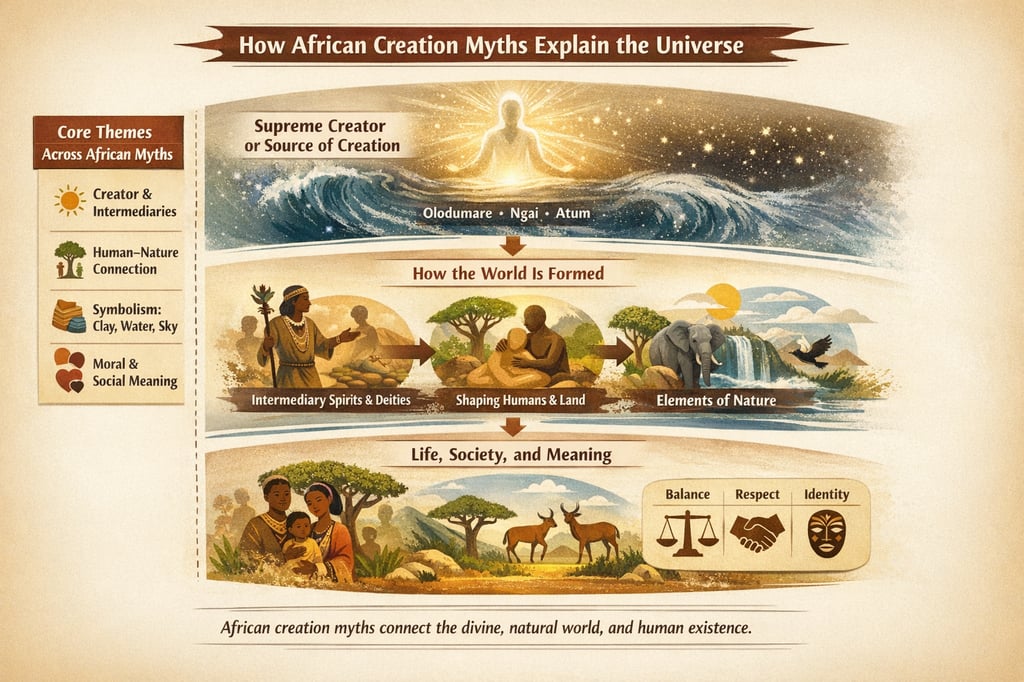
Common themes include a supreme creator, the role of intermediaries, the importance of balance, and the connection between humans, nature, and the spiritual world.
Even though African myths are diverse, several patterns appear repeatedly:
1. A Supreme Creator
Many traditions include a high god who initiates creation. This being may remain distant after creation.
2. Intermediary Spirits or Deities
Creation often involves assistants, such as lesser gods, tricksters, or ancestors who shape the world more directly.
3. Creation Through Word or Action
Some myths describe creation through speech. Others show physical acts like molding humans from clay or sending beings from the sky.
4. Human-Nature Connection
Humans are rarely separate from nature. They are part of a larger system that includes animals, land, and spiritual forces.
5. Imperfection or Change
In several myths, the world is not perfect from the start. Mistakes or conflicts shape its current form.
These themes reflect deep philosophical ideas about existence, responsibility, and balance.
Regional Examples of African Creation Myths
Different African regions have distinct creation myths, each reflecting local beliefs, environments, and social structures.
West Africa: Yoruba Creation Myth
The Yoruba people of Nigeria tell a well-known story involving the god Olodumare and the deity Obatala.
Obatala is sent to create land from a watery world. Using sand and a chicken, he spreads land across the surface. Humans are later formed from clay.
This myth highlights divine delegation and the importance of order.
Central Africa: Bantu Creation Stories
Many Bantu-speaking groups share similar ideas, though details vary.
In some versions, a creator god brings humans into existence but then withdraws. Humans must rely on ancestors and spirits for guidance.
This reflects a layered spiritual system where direct access to the creator is limited.
East Africa: Kikuyu Creation Myth
The Kikuyu people of Kenya believe that God, Ngai, created the first man, Gikuyu, and placed him near Mount Kenya.
Gikuyu is given a wife and daughters, who become the founders of clans.
This myth connects geography, ancestry, and identity very clearly.
Southern Africa: San (Bushmen) Myth
The San people describe creation through a more fluid and symbolic lens.
In some stories, the trickster figure /Kaggen transforms into different forms and influences the world.
These myths often blur the line between humans, animals, and spirits.
North Africa: Ancient Egyptian Creation Myth
Ancient Egypt offers one of the earliest recorded African creation systems.
In one version, the god Atum creates himself from chaos and then brings forth other gods, leading to the creation of the world.
This myth is more structured and reflects early state-level religion.
Differences Between African Creation Myths and Other Traditions
African creation myths differ from many global traditions in their diversity, emphasis on community, and strong integration of nature and spirituality.
While many cultures have creation stories, African myths stand out in several ways:
No single narrative: There is no universal African creation story. Each culture has its own version.
Oral tradition: Many myths are passed through storytelling rather than written texts.
Flexible interpretation: Stories can evolve over time without losing meaning.
Community focus: Creation often involves relationships rather than isolated events.
Compared to more rigid or centralized traditions, African myths tend to be more adaptable and context-driven.
Symbolism in African Creation Myths
Symbols in African creation myths represent deeper ideas about life, power, nature, and the human condition.
Understanding symbolism helps you go beyond the surface of these stories.
Common symbols include:
Water: Often represents chaos or the beginning state of existence.
Clay or earth: Symbolizes human origin and connection to land.
Animals: Act as messengers, creators, or tricksters.
Sky and distance: Reflect separation between humans and divine beings.
These symbols are not random. They reflect the environment and worldview of each culture.
How African Creation Myths Are Passed Down
African creation myths are primarily transmitted through oral traditions, including storytelling, rituals, and community practices.
Oral tradition is central to African cultural preservation.
Stories are shared through:
Elders and storytellers
Ceremonies and rituals
Songs and performances
This method allows myths to stay relevant. Details may shift slightly, but core meanings remain intact.
Today, many of these stories are also recorded in books and academic studies, helping preserve them for global audiences.
Common Misconceptions About African Creation Myths
Many misconceptions arise from oversimplification, such as treating Africa as a single culture or assuming myths are primitive or outdated.
Misconception 1: There is one African myth
Africa contains thousands of cultures. Each has its own story.
Misconception 2: Myths are not relevant today
These stories still influence beliefs, identity, and traditions.
Misconception 3: Myths are simple or unsophisticated
Many African myths contain complex philosophical ideas about existence and morality.
Understanding these points helps you approach the topic with respect and accuracy.
Academic and Cultural Importance
African creation myths are valuable in fields such as anthropology, history, religious studies, and cultural preservation.
Scholars study these myths to understand:
Social structures
Belief systems
Historical context
Linguistic patterns
They also play a role in preserving intangible cultural heritage.
For educators and content creators, these myths provide rich material that connects storytelling with deeper human questions.
How to Study African Creation Myths Effectively
Effective study involves comparing different traditions, understanding cultural context, and analyzing symbolism rather than focusing only on the story itself.
If you want to go deeper:
Study by region rather than treating Africa as one unit
Compare themes across cultures
Look at historical context
Analyze symbols and meanings
You can also explore related topics like oral tradition, African cosmology, and mythology comparisons.
Frequently Asked Questions
What is the main idea of African creation myths?
African creation myths explain how the world and humanity began, while also reflecting cultural values, spiritual beliefs, and relationships between humans, nature, and the divine.
Are African creation myths similar across all cultures?
No, they vary widely. Each culture has its own version shaped by its environment, language, and social structure, though some shared themes appear across regions.
Who are the main gods in African creation myths?
Different myths feature different deities. Examples include Olodumare in Yoruba belief and Ngai in Kikuyu tradition. There is no single universal god across all African myths.
Are these myths still relevant today?
Yes, many communities continue to value and share these stories. They influence identity, traditions, and spiritual practices even in modern contexts.
How were African creation myths preserved before writing?
They were passed down orally through storytelling, rituals, songs, and community gatherings, often led by elders or designated storytellers.
What makes African creation myths unique?
Their diversity, strong connection to nature, and emphasis on community and relationships make them distinct from many other mythological traditions.
Understanding African creation myths gives you more than knowledge. It gives you perspective.
You start to see how different cultures answer the same universal questions in their own ways. That shift alone can change how you think about history, identity, and belief.
If you want to go deeper, explore specific regional myths or compare African stories with other global traditions.
Clear, structured knowledge helps you connect the dots with confidence.
usefulservices24@gmail.com
© 2026 Tales of Africa. All rights reserved. Powered by MSGDigitals.com