
First African Champions League Winners
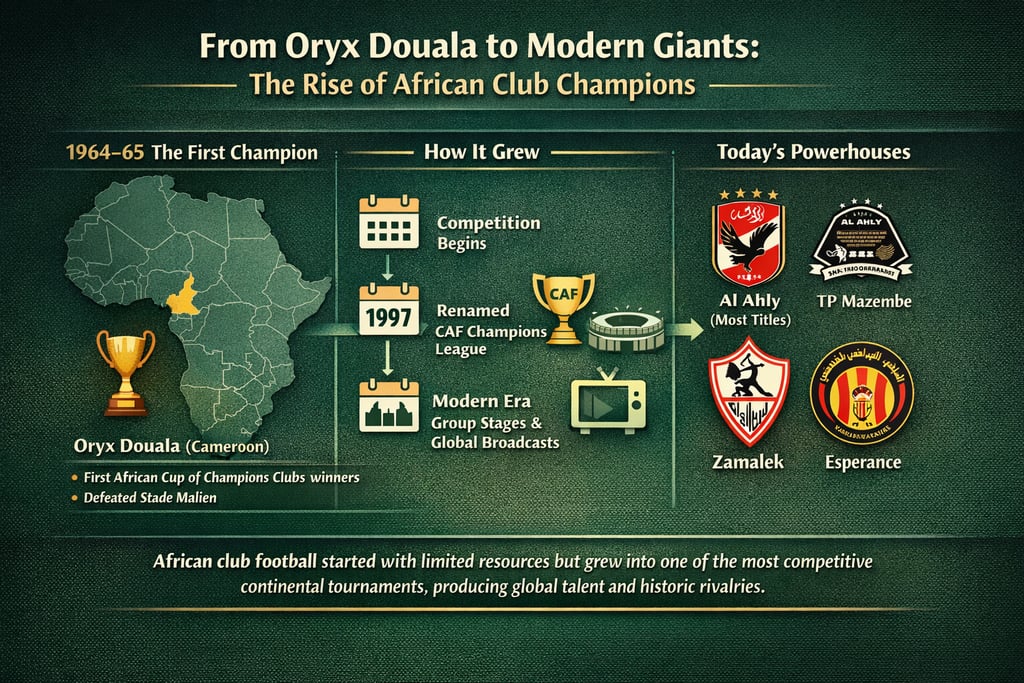
The first winners of Africa’s premier club competition, now called the CAF Champions League, were Oryx Douala of Cameroon, who won the inaugural 1964–65 African Cup of Champions Clubs, defeating Stade Malien in the final.
SPORTS
Godha
3/29/20266 min read
First African Champions League Winners
Football history often hides its most important beginnings in plain sight. When people talk about African club dominance today, names like Al Ahly or TP Mazembe come up. But it all started with a lesser-known pioneer.
Understanding who won first, and why it matters, gives you a clearer picture of how African football evolved into a global force.
What Were the First African Champions League Winners?
Oryx Douala from Cameroon were the first African champions in club football. They won the inaugural 1964–65 African Cup of Champions Clubs, which later became the CAF Champions League.
The competition we now know as the CAF Champions League began in the 1960s under a different name: the African Cup of Champions Clubs. It was launched by the Confederation of African Football (CAF) to crown the best club team on the continent.
Oryx Douala emerged as the first-ever winner. They defeated Stade Malien from Mali in the final, marking a historic moment not only for Cameroon but for African football as a whole.
This victory wasn’t just about a trophy. It symbolized the beginning of organized continental club competition in Africa, similar to what the UEFA Champions League represents in Europe.
How Did the African Champions League Begin?
The tournament started in 1964 as the African Cup of Champions Clubs. It was created to bring together national league winners across Africa and determine the continent’s best club team.
In the early 1960s, many African nations had recently gained independence. Football quickly became a unifying force. However, there was no structured way to determine the best club across countries.
CAF introduced the African Cup of Champions Clubs to fill that gap. Only league champions from each country were invited. This format ensured high-quality competition right from the start.
The structure was simple. Knockout rounds decided progression, and the final crowned the champion. There were no group stages or complex formats like today.
This simplicity gave early winners like Oryx Douala a unique place in history. They didn’t just win a tournament. They helped establish a continental identity for African club football.
To fully understand why Oryx Douala’s victory matters, it helps to look even further back at the roots of the game on the continent.
Many of the clubs that competed in early continental tournaments were built on foundations laid decades earlier, as explored in Oldest Football Clubs in Africa History and Legacy.
These early institutions shaped local football cultures, created structured competitions, and developed the talent pipelines that made a continental tournament possible in the first place.
Who Were Oryx Douala and Why Are They Important?
Oryx Douala were a Cameroonian football club that dominated locally in the 1960s. Their continental victory made them the first African club champions and pioneers of cross-border competition.
Oryx Douala were based in Douala, Cameroon’s largest city and a key football hub. During the 1960s, the club was one of the strongest in the country.
Their domestic success earned them qualification for the first African Cup of Champions Clubs. What makes them remarkable is that they adapted quickly to international competition, which was still new for many teams.
They didn’t have the resources or infrastructure modern clubs enjoy. Travel was difficult. Training methods were basic. Yet they managed to outperform champions from across the continent.
Today, Oryx Douala is often mentioned in historical discussions but rarely celebrated at the level they deserve. Their win laid the foundation for every African club that followed.
What Happened in the 1964–65 Final?
Oryx Douala defeated Stade Malien in the final of the inaugural competition. The victory secured their place as the first African club champions in history.
The final was contested between two strong teams: Oryx Douala and Stade Malien. Both had proven themselves through knockout rounds against other national champions.
Unlike modern finals held in neutral venues, early African finals were often played over two legs or under different logistical arrangements. Records from that era are sometimes incomplete, but the result is clear.
Oryx Douala emerged victorious, marking Cameroon’s first continental club success. Stade Malien, however, also played a crucial role in setting competitive standards.
This final was more than a match. It was proof that African clubs could compete across borders and create a shared football culture.
How Did the Competition Evolve Into the CAF Champions League?
The African Cup of Champions Clubs was rebranded as the CAF Champions League in 1997. The format expanded to include group stages, increased commercial value, and broader participation.
Over time, African football grew in popularity and organization. CAF recognized the need to modernize its flagship competition.
In 1997, the tournament was officially renamed the CAF Champions League. This change aligned it more closely with global standards, especially Europe’s Champions League.
Key changes included:
Introduction of group stages
Increased prize money
Television broadcasting deals
Sponsorship and branding improvements
These developments helped African clubs gain more exposure internationally. Today, clubs like Al Ahly, Esperance, and Wydad Casablanca dominate headlines.
Why Does the First Winner Still Matter Today?
The first winner represents the origin of African club football at a continental level. It provides historical context for today’s competition and highlights how far African football has progressed.
When you look at modern African football, it’s easy to focus on recent champions. But the roots of the competition tell a deeper story.
Oryx Douala’s victory shows how football helped connect newly independent nations. It also demonstrates how the sport developed without the infrastructure seen in Europe or South America.
For fans, historians, and analysts, knowing the first winner adds depth to the competition. It transforms the CAF Champions League from just a tournament into a legacy.
Understanding this history also helps explain current dominance patterns, investment trends, and regional strengths.
If you’ve already explored the broader timeline in my article on African Champions League History, you’ll notice how the journey begins with clubs like Oryx Douala.
Their 1964–65 triumph wasn’t an isolated moment.
It set the tone for decades of tactical evolution, regional rivalries, and shifting dominance that shaped the competition into what you see today.
How Does African Club Football Compare Globally?
African club football has grown significantly but still faces structural challenges compared to Europe and South America. However, its talent production and competitive spirit remain globally respected.
African football clubs operate under different conditions. Financial constraints, infrastructure limitations, and travel challenges affect performance.
Despite this, African clubs consistently produce world-class players. Many top footballers in Europe began their careers in African leagues.
The CAF Champions League has also improved in quality and organization. Broadcasting deals and sponsorships have increased visibility.
Comparing competitions:
UEFA Champions League has higher revenue and global reach
Copa Libertadores has strong regional dominance
CAF Champions League is rapidly growing and talent-rich
Which Clubs Became Dominant After the First Winners?
After Oryx Douala, clubs like Al Ahly, TP Mazembe, Zamalek, and Esperance rose to dominance. These teams shaped the competitive landscape of African club football over decades.
While Oryx Douala started it all, they didn’t maintain long-term dominance. Other clubs stepped in and built lasting legacies.
Al Ahly of Egypt is the most successful club in African Champions League history. Their consistency, investment, and structure set them apart.
TP Mazembe from DR Congo also became a powerhouse, especially in the 1960s and 1970s. They even competed strongly on the global stage.
Zamalek and Esperance further expanded North Africa’s influence on the competition.
These clubs benefited from improved infrastructure, stronger leagues, and better organization. They built on the foundation created by early winners like Oryx Douala.
What Challenges Did Early African Competitions Face?
Early competitions faced logistical issues, limited funding, travel difficulties, and inconsistent participation. Despite these challenges, the tournament succeeded and grew into a major continental event.
Running a continental competition in the 1960s was not easy. Many countries lacked stable infrastructure. Flights were limited. Communication was slow.
Clubs often struggled to travel across the continent. Some matches were postponed or canceled due to logistical issues.
Funding was another major challenge. Unlike today, there were no major sponsors or broadcasting deals.
Yet, the competition survived. That resilience is part of what makes the early winners so important. They competed under conditions far more difficult than modern teams.
How Can You Use This Knowledge Today?
Understanding the first winners helps you analyze African football history, appreciate its growth, and gain deeper insight into current competitions and club dominance patterns.
If you follow football closely, knowing the origins of major competitions gives you an edge. It helps you:
Understand why certain regions dominate
Analyze club development patterns
Appreciate historical context in modern matches
For writers, bloggers, and analysts, this knowledge adds authority to your content.
For fans, it simply makes the game more meaningful. You’re not just watching matches. You’re witnessing a legacy that started decades ago.
Frequently Asked Questions
Who won the first CAF Champions League?
Oryx Douala of Cameroon won the first edition in 1964–65. At the time, the competition was called the African Cup of Champions Clubs.
When did the CAF Champions League start?
The competition began in 1964. It was later rebranded as the CAF Champions League in 1997 to reflect its modern format and global alignment.
Which country had the first African club champion?
Cameroon was the first country to produce a continental club champion, thanks to Oryx Douala’s victory.
Is Oryx Douala still active today?
Yes, Oryx Douala still exists, though it no longer dominates African football like it did in the 1960s.
Why was the competition renamed?
CAF renamed the tournament to align with global standards, improve branding, and introduce a more modern format including group stages.
Which club has won the most CAF Champions League titles?
Al Ahly of Egypt holds the record for the most titles, making them the most successful club in African football history.
Final Thoughts
The story of the first African Champions League winners isn’t just about a club. It’s about the birth of a continental identity in football.
When you look at today’s packed stadiums and global broadcasts, it’s easy to forget where it began.
A modest team from Cameroon, limited resources, and a brand-new competition.
That’s where African club football truly started.
About The Author
Mubashir Shakoor Godha is a blogger, digital marketer, and SEO specialist based in Pakistan. He started his journey in 2019 on Blogger and has since built and managed multiple websites that rank on Google and AI driven search platforms.
He is also the Founder of MSG Digitals, Top Rated Digital Marketing Agency in Pakistan, where he helps businesses grow through SEO, content strategy, and performance marketing.

usefulservices24@gmail.com
© 2026 Tales of Africa. All rights reserved. Powered by MSGDigitals.com