
Oldest Football Clubs in Nigeria
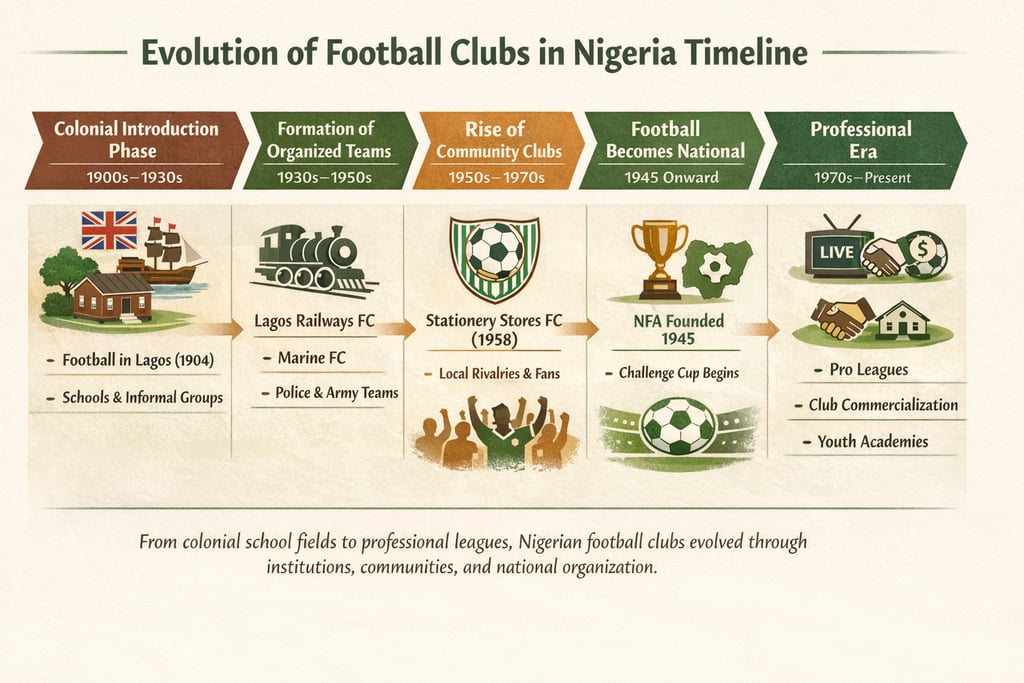
The oldest football clubs in Nigeria include Lagos-based teams like Stationery Stores FC, established in 1958, and earlier colonial-era clubs tied to institutions, missionary schools, and expatriate communities that shaped organized football in Nigeria.
SPORTS
Godha
3/22/20266 min read
Oldest Football Clubs in Nigeria and Their Legacy
Football in Nigeria did not start with modern professional leagues. It grew from colonial influence, school competitions, and community clubs that slowly evolved into organized teams.
If you look closely, many of today’s football structures in Nigeria still reflect those early foundations.
What are the oldest football clubs in Nigeria?
The oldest football clubs in Nigeria emerged during the colonial period, mostly between the early 1900s and the late 1950s. These clubs were often tied to schools, companies, or expatriate communities rather than formal professional systems.
Football arrived in Nigeria through British colonial administrators, missionaries, and merchants in the early 20th century. Early teams were informal but gradually became structured clubs, especially in Lagos, which served as the administrative and commercial center.
Unlike European clubs that have continuous documented histories, many early Nigerian clubs were not formally registered or preserved in archives. This makes identifying the “oldest” clubs slightly complex. However, historians generally recognize several pioneering teams that laid the foundation for organized football.
These early clubs fall into three categories:
Institutional teams (schools, railways, police)
Community clubs (local neighborhoods and social groups)
Company-backed teams (trading firms and corporations)
This blend shaped Nigerian football culture in a unique way.
How did football start in Nigeria?
Football began in Nigeria in the early 1900s through British colonial influence, particularly in Lagos. Missionary schools and government institutions introduced the sport, which quickly spread among local communities and became a popular recreational activity.
The first recorded football match in Nigeria is believed to have taken place in 1904 in Lagos. British expatriates and Nigerian elites educated in mission schools played a major role in introducing the game.
Mission schools like CMS Grammar School and Methodist Boys High School used football as part of physical education. Students carried the sport into their communities, forming informal clubs.
By the 1930s and 1940s, football had already become a social activity tied to:
Urban identity
Youth engagement
Community pride
The sport’s growth led to the formation of organized competitions such as the Lagos League, which later influenced national structures.
If you’ve explored the history of the oldest football clubs in South Africa, you’ll notice a similar pattern in Nigeria.
Both countries saw football grow through colonial influence, schools, and worker-based teams before evolving into organized club systems.
The key difference lies in how each region structured its early competitions and preserved club identities, with Nigeria’s development centered heavily in Lagos, while South Africa’s growth spread across multiple urban centers shaped by social and political factors.
Which clubs are considered among the oldest in Nigeria?
Notable early Nigerian football clubs include Stationery Stores FC, Lagos Railways FC, Marine FC, and various school-based teams. These clubs were among the earliest organized teams that contributed to structured football competitions in Nigeria.
While records are fragmented, several clubs consistently appear in historical discussions.
Stationery Stores FC (1958)
Stationery Stores FC is one of the most iconic early clubs in Nigeria. Founded in Lagos, it became a powerhouse in Nigerian football and gained massive popularity.
Key facts:
Founded by Israel Adebajo
Known as “Flaming Flamingos”
Produced several national team players
Lagos Railways FC
Railway workers formed this club during the colonial era. It played a major role in early league competitions.
Key characteristics:
Strong institutional backing
Organized structure earlier than many community clubs
Competitive presence in Lagos football
Marine FC
Marine FC represented workers in the maritime sector. It was part of early organized competitions in Lagos.
Police and Army Teams
Security forces also formed teams that became competitive units. These teams contributed to discipline and structure in early Nigerian football.
Why is Lagos central to early Nigerian football history?
Lagos was the center of early Nigerian football because it was the colonial capital and a hub for trade, education, and administration. Most early clubs, competitions, and football infrastructure developed there first.
If you trace Nigerian football history, Lagos appears repeatedly.
There are clear reasons for this:
It hosted British colonial administrators
It had the earliest schools and institutions
It was the main port city
It attracted diverse populations
This environment created the perfect conditions for football to grow quickly.
Early leagues like the Lagos Amateur Football Association (LAFA) organized competitions that set the template for national football systems.
Many clubs that started in Lagos influenced football culture across Nigeria.
If you zoom out beyond Nigeria, the story becomes even more interesting. Many of the structures seen in Nigeria mirror patterns across the continent.
In fact, when studying the Oldest Football Clubs in Africa, you’ll notice a similar origin story, colonial influence, school systems, and institution-backed teams shaping early football.
What makes Nigeria unique is how quickly these early foundations translated into strong community clubs and competitive national structures, especially in Lagos.
What role did schools play in forming early clubs?
Schools played a foundational role in Nigerian football by introducing the sport to young people. Many early clubs were formed by students and alumni who continued playing after leaving school.
Before professional clubs existed, schools were the main entry point into football.
Students learned:
Basic rules of the game
Team organization
Competitive play
After graduation, these players formed clubs in their communities.
Some of the earliest structured teams were essentially extensions of school football culture.
Schools like:
CMS Grammar School
King’s College Lagos
were central to early football development.
How did colonial institutions shape early football clubs?
Colonial institutions such as railways, police, and government offices created structured teams that became some of the earliest football clubs in Nigeria, providing organization, funding, and competition frameworks.
Colonial institutions had resources that local communities often lacked.
This allowed them to:
Provide equipment
Organize matches
Maintain regular training
Railway workers, for example, had structured schedules and communities, making it easier to form teams.
These institutional clubs introduced:
Discipline
Tactical organization
Competitive consistency
This influence is still visible in Nigerian football today, especially in government-backed clubs.
When did Nigerian football become organized nationally?
Nigerian football became nationally organized in 1945 with the establishment of the Nigeria Football Association (now Nigerian Football Federation), which unified regional competitions and formalized the sport across the country.
Before 1945, football in Nigeria was largely regional.
The formation of the Nigeria Football Association (NFA) changed everything.
It introduced:
Standard rules
National competitions
Structured governance
This led to the creation of tournaments like:
The Challenge Cup (now FA Cup)
Which early competitions shaped Nigerian clubs?
Early competitions like the Lagos League and the Challenge Cup played a major role in shaping Nigerian football clubs by providing structured tournaments and fostering rivalries that strengthened club identities.
Competitions gave clubs purpose and visibility.
Lagos League
One of the earliest organized competitions
Based in Lagos
Featured top early clubs
Challenge Cup (FA Cup)
Established in 1945
Open to clubs nationwide
Became Nigeria’s most prestigious early tournament
These competitions helped clubs grow beyond local recognition.
They also created:
Fan bases
Rivalries
Competitive standards
How did early Nigerian clubs differ from modern clubs?
Early Nigerian clubs were community or institution-based with limited funding and informal structures, while modern clubs operate professionally with sponsorships, academies, and advanced management systems.
The difference between early and modern clubs is significant.
Early Clubs
Informal management
Limited funding
Community-driven
Minimal infrastructure
Modern Clubs
Professional contracts
Corporate sponsorships
Youth academies
Media presence
Despite these differences, the core idea remains the same: representing identity and community.
What impact did early clubs have on Nigerian football today?
Early football clubs in Nigeria laid the foundation for modern football structures, influencing league systems, player development, fan culture, and national team success.
Without early clubs, Nigerian football would not exist in its current form.
Their contributions include:
Establishing football culture
Creating competition structures
Developing early talents
Building fan engagement
Many modern clubs still follow patterns set by these early teams.
Even the Super Eagles benefit from a system that evolved from these roots.
Why is documenting old Nigerian clubs difficult?
Documenting early Nigerian football clubs is challenging due to limited historical records, lack of formal registration, and poor archival practices during the colonial and early post-independence periods.
Many early clubs were not officially registered.
Records were:
Not preserved
Scattered across institutions
Sometimes lost entirely
This makes it hard to verify exact founding dates.
Historians rely on:
Newspaper archives
Oral histories
Institutional records
Are any of the oldest clubs still active today?
Some of Nigeria’s oldest clubs, like Stationery Stores FC, have experienced periods of inactivity but still exist in some form, while others have dissolved or evolved into modern clubs.
Football in Nigeria has gone through economic and administrative changes.
As a result:
Some clubs folded
Others rebranded
A few survived with interruptions
Stationery Stores FC, for example, remains one of the most recognized historic clubs despite fluctuating activity.
This reflects the broader reality of football development in emerging systems.
What lessons can modern football learn from early Nigerian clubs?
Modern football can learn from early Nigerian clubs by focusing on community engagement, grassroots development, and strong local identity, which were central to the success and popularity of early teams.
Early clubs were deeply connected to their communities.
They built loyalty through:
Local identity
Accessibility
Participation
Modern football sometimes loses this connection.
Reintroducing these principles can:
Strengthen fan bases
Improve youth development
Sustain long-term growth
Frequently Asked Questions
What is the oldest football club in Nigeria?
There is no single universally agreed oldest club due to limited historical records. However, early institutional teams and clubs like Stationery Stores FC are often recognized among the oldest organized teams.
When was football first played in Nigeria?
Football was first played in Nigeria around 1904 in Lagos, introduced by British colonial administrators and missionaries. It quickly spread through schools and local communities.
Why are many early Nigerian clubs not well documented?
Many early clubs lacked formal registration and record-keeping. Poor archival systems and colonial-era limitations contributed to gaps in historical documentation.
Which city had the first football clubs in Nigeria?
Lagos had the first football clubs because it was the colonial capital and a center for education, trade, and administration, making it the natural starting point for organized football.
Are old Nigerian football clubs still important today?
Yes, they are important because they shaped the structure, culture, and development of modern Nigerian football. Their influence is still visible in leagues, competitions, and fan traditions.
If you look at Nigerian football today, from local leagues to international tournaments, you’re really seeing the outcome of decades of gradual growth.
Those early clubs may not all exist anymore, but their impact hasn’t disappeared. It’s still playing out every time a match kicks off.
About The Author
Mubashir Shakoor Godha is a blogger, digital marketer, and SEO specialist based in Pakistan. He started his journey in 2019 on Blogger and has since built and managed multiple websites that rank on Google and AI driven search platforms.
He is also the Founder of MSG Digitals, Top Rated Digital Marketing Agency in Pakistan, where he helps businesses grow through SEO, content strategy, and performance marketing.

usefulservices24@gmail.com
© 2026 Tales of Africa. All rights reserved. Powered by MSGDigitals.com