
Oldest Football Clubs in South Africa
The oldest football clubs in South Africa emerged in the late 19th century, with teams like Savages FC, Durban City, and amateur colonial-era sides laying foundations for organized football, later influencing modern professional leagues and national structures.
SPORTS
Godha
3/21/20266 min read
Oldest Football Clubs in South Africa Explained
Football in South Africa has deep roots, shaped by colonial influence, local communities, and evolving social dynamics. If you look closely, the history of its oldest clubs tells a much bigger story than just sport.
Let’s break it down in a way that actually helps you understand how South African football started, who the key pioneers were, and why these early clubs still matter today.
What Are the Oldest Football Clubs in South Africa?
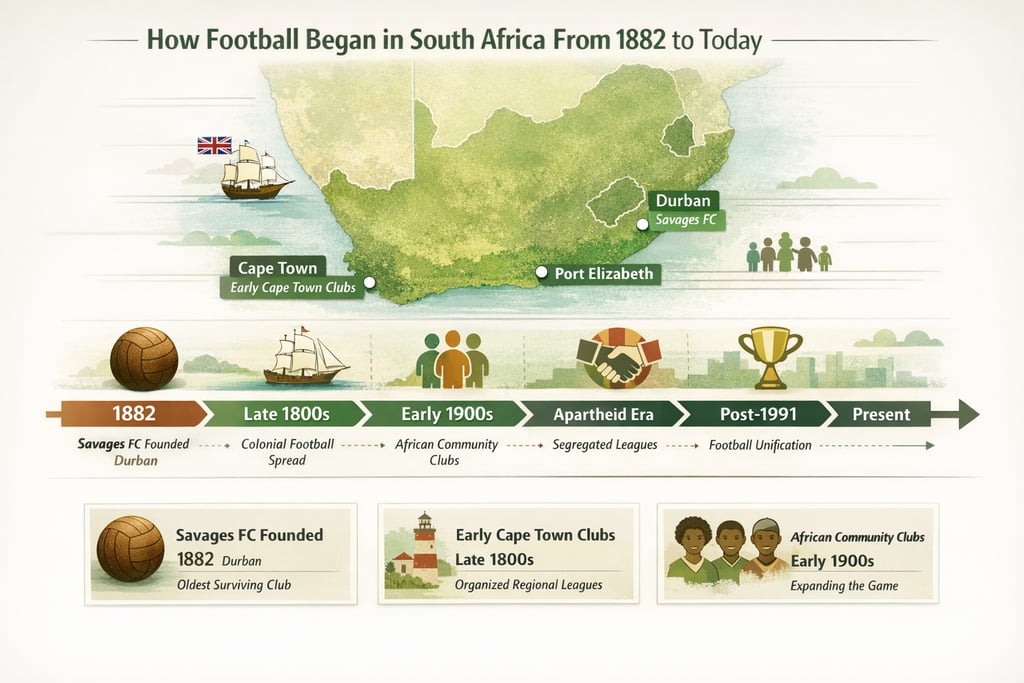
The oldest football clubs in South Africa date back to the late 1800s, with Savages FC (Durban) often cited as the earliest established club in 1882. Several amateur colonial clubs also contributed to early football development.
Football arrived in South Africa through British soldiers, sailors, and settlers during the 19th century. Initially, the game was played informally among colonial communities before structured clubs began to form.
Savages Football Club, founded in Durban in 1882, is widely recognized as one of the oldest surviving clubs. It started as a rugby club before adopting association football, reflecting how early sports organizations often overlapped.
Other early clubs included teams linked to schools, military units, and port cities like Cape Town and Port Elizabeth. These clubs were not always formally documented, which makes historical verification challenging.
What matters is this: football in South Africa didn’t begin with professional leagues. It began with community-driven clubs that laid the groundwork for everything that followed.
Why Did Football Develop Early in South Africa?
Football developed early in South Africa due to British colonial influence, urban port cities, and the presence of military and educational institutions that introduced and organized the sport among local and expatriate communities.
If you trace the timeline, South Africa was one of the first African countries to adopt football. This wasn’t accidental.
British colonial expansion brought structured sports culture, including football rules, leagues, and competitions. Soldiers often played matches during downtime, which sparked local interest.
Urban centers like Durban, Cape Town, and Johannesburg became hubs for early football. These cities had infrastructure, schools, and clubs that allowed the sport to spread quickly.
At the same time, local African communities began forming their own teams. These clubs played a critical role in making football more inclusive, even during periods of segregation.
If you’ve explored the history of the oldest football clubs in Egypt, you’ll notice a similar pattern of early football development shaped by British influence and urban centers.
Both Egypt and South Africa saw clubs emerge in the late 19th and early 20th centuries, but their paths diverged in how local communities adapted the game.
In Egypt, institutions like Al Ahly quickly became symbols of national identity, while in South Africa, early clubs evolved through a more fragmented system shaped by regional and social divisions.
Looking at both histories side by side gives you a clearer view of how football spread across Africa, not as a single story, but as multiple parallel developments influenced by local conditions.
Which Clubs Are Considered the Oldest in South African Football?
Savages FC is the most widely recognized oldest club (1882), followed by early regional clubs in Cape Town and Port Elizabeth. Many early African clubs formed later but became central to football’s growth in the 20th century.
Let’s look at the key early clubs that shaped South African football:
Savages FC (1882, Durban)
Often cited as the oldest surviving club. It represents the transition from informal play to structured competition.
Early Cape Town Clubs
Cape Town had several early football entities tied to British communities. These clubs contributed to organized leagues in the Western Cape.
Port Elizabeth and Eastern Cape Clubs
The Eastern Cape became a stronghold for early football development, especially among working-class communities.
African Community Clubs (Early 1900s)
Clubs formed by Black South Africans played a major role in expanding the sport. These teams often operated outside official colonial leagues due to segregation policies.
These clubs may not always appear in global rankings, but they are essential if you want a true picture of football history in South Africa.
How Did Early Clubs Influence Modern South African Football?
Early football clubs established league systems, playing standards, and community engagement models that directly influenced modern structures like the Premier Soccer League and national team development in South Africa.
Modern South African football didn’t appear overnight. It evolved from these early clubs in several key ways:
1. League Formation
Early clubs organized matches and informal competitions. These later evolved into structured leagues, which eventually became today’s professional system.
2. Football Governance
Clubs contributed to the creation of governing bodies. These organizations standardized rules and competition formats.
3. Talent Development
Local clubs acted as the first training grounds for players. Even today, grassroots football follows a similar model.
4. Cultural Identity
Football became deeply tied to identity and resistance, especially during apartheid. Clubs were more than teams. They were community symbols.
This legacy still shapes how football is experienced in South Africa today.
What Role Did Apartheid Play in Football Club Development?
Apartheid created segregated football systems, dividing clubs by race and limiting competition, but it also led to strong independent leagues within marginalized communities that preserved and strengthened football culture.
During apartheid, football was segregated into separate racial associations. White clubs had access to better facilities and international recognition, while Black, Coloured, and Indian clubs were excluded.
But something important happened.
Communities didn’t stop playing. Instead, they built their own leagues and structures. These independent systems became incredibly competitive and passionate.
Some of today’s biggest football institutions in South Africa trace their roots back to these segregated leagues.
Are Any of the Oldest Clubs Still Active Today?
Yes, some of the oldest clubs like Savages FC are still active today, primarily at amateur or regional levels, maintaining their historical legacy while contributing to grassroots football development.
Not all early clubs survived, but some did.
Savages FC, for example, continues to operate. It may not compete at the top professional level, but its existence is a direct link to football’s origins in South Africa.
Other clubs have evolved, merged, or been rebranded over time. This makes tracking “oldest clubs” tricky, as continuity isn’t always straightforward.
Still, their influence lives on through:
Youth academies
Regional leagues
Community football programs
If you care about football history, these clubs are living artifacts.
How Do South Africa’s Oldest Clubs Compare Globally?
South Africa’s oldest clubs emerged later than European clubs but are among the earliest in Africa, playing a key role in spreading organized football across the continent during the colonial and early modern periods.
Globally, football clubs in England date back to the mid-1800s. Compared to that, South African clubs appeared slightly later.
But here’s the key point.
Within Africa, South Africa was ahead of most countries. Its early adoption of football helped influence neighboring regions.
This gave South Africa a unique position:
Early adopter in Africa
Bridge between European and African football systems
Contributor to continental competitions
You can compare timelines through for a broader perspective.
What Makes a Football Club “Oldest”?
A football club is considered “oldest” based on its founding date, continuity of operation, and historical documentation, though mergers and name changes can complicate accurate classification.
This question matters more than it seems.
To classify a club as “oldest,” historians look at:
Founding Date
When the club was officially established.
Continuous Existence
Has the club operated without interruption?
Documentation
Are there records to support its history?
In South Africa, this gets tricky due to incomplete records and political disruptions. Some clubs existed informally before being officially registered.
So when you see claims about “oldest clubs,” they often depend on interpretation.
Why Do Old Football Clubs Still Matter Today?
Old football clubs matter because they preserve heritage, shape community identity, and provide foundational structures for youth development, ensuring continuity between past traditions and modern football systems.
You might wonder why this history still matters.
Football isn’t just about today’s matches. It’s about legacy.
Old clubs:
Preserve cultural identity
Inspire younger generations
Provide grassroots pathways
Keep local football alive
In many communities, these clubs are symbols of pride and continuity.
Frequently Asked Questions
What is the oldest football club in South Africa?
Savages FC, founded in 1882 in Durban, is widely considered the oldest football club in South Africa. It began as a rugby club before transitioning into association football and still exists today.
When did football start in South Africa?
Football began in South Africa in the late 19th century, introduced by British soldiers and settlers. Organized clubs started forming in the 1880s, especially in port cities like Durban and Cape Town.
Are there professional clubs among the oldest teams?
Most of the oldest clubs are now amateur or semi-professional. Modern professional clubs in South Africa were established later, often in the mid to late 20th century.
How did apartheid affect football clubs?
Apartheid created segregated leagues based on race, limiting competition and resources. However, it also led to strong independent football systems within marginalized communities.
Why is Savages FC important in football history?
Savages FC represents the early adoption of organized football in South Africa. Its long history makes it a key reference point for understanding how the sport developed in the region.
Final Thoughts
If you look at South Africa’s oldest football clubs, you’re not just looking at teams. You’re looking at the roots of an entire football culture.
What started in small colonial communities grew into one of Africa’s strongest football ecosystems.
And even today, those early clubs still echo in every match played across the country.
About The Author
Mubashir Shakoor Godha is a blogger, digital marketer, and SEO specialist based in Pakistan. He started his journey in 2019 on Blogger and has since built and managed multiple websites that rank on Google and AI driven search platforms.
He is also the Founder of MSG Digitals, Top Rated Digital Marketing Agency in Pakistan, where he helps businesses grow through SEO, content strategy, and performance marketing.

usefulservices24@gmail.com
© 2026 Tales of Africa. All rights reserved. Powered by MSGDigitals.com