
African Champions League History
The African Champions League is Africa’s premier club football competition, founded in 1964, evolving into a continent-wide tournament featuring elite clubs, historic rivalries, and dominant dynasties that shaped African football’s global identity and legacy.
SPORTS
Godha
3/28/20266 min read
African Champions League History Explained
If you’ve ever followed African football, you’ve likely noticed how deeply the Champions League shapes club prestige across the continent. It is not just a tournament, it is a marker of identity, dominance, and history.
What is the African Champions League?
The African Champions League is the top-tier club competition in African football, organized by the Confederation of African Football (CAF). It determines the best club team across Africa each season.
The competition is officially known as the CAF Champions League, governed by the . It brings together league champions and top-performing clubs from CAF member nations.
Unlike domestic leagues, this tournament tests clubs across borders, climates, and playing styles. You see North African tactical discipline collide with West African flair and Southern African structure.
Winning it is the highest honor at club level in Africa. It also qualifies teams for the FIFA Club World Cup, linking African football to the global stage.
How did the African Champions League begin?
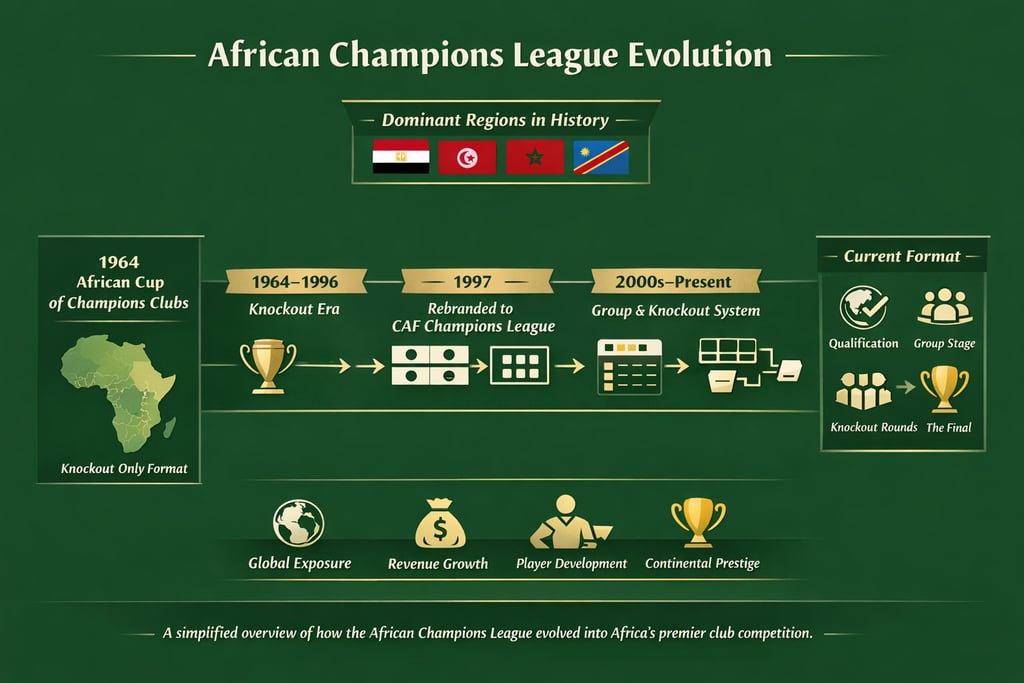
The competition began in 1964 as the African Cup of Champions Clubs, inspired by Europe’s model. It was initially a knockout tournament featuring league champions from African countries.
When it started, African football was still developing structured continental competitions. The format was simple: national champions faced each other in two-legged knockout ties.
The first winner was Oryx Douala of Cameroon. Back then, travel challenges, political instability, and limited infrastructure made participation difficult. Some clubs even withdrew due to logistical issues.
Despite these challenges, the tournament laid the foundation for continental rivalry. It mirrored the European Cup but adapted to Africa’s realities.
In 1997, CAF rebranded it to the CAF Champions League, introducing a group stage format. This change transformed it into a more commercially viable and competitive tournament.
How has the format evolved over time?
The African Champions League evolved from a straight knockout format into a multi-stage competition with preliminary rounds, group stages, and knockout rounds, increasing competitiveness and revenue opportunities.
The modern format includes:
Preliminary Rounds
Lower-ranked teams compete to qualify for the main stages. This ensures wider representation across Africa.
Group Stage
Top teams are divided into groups, playing home-and-away matches. This stage improved consistency and reduced randomness.
Knockout Stage
Quarterfinals, semifinals, and finals determine the champion. These matches often attract global attention.
This structure allows clubs to play more matches, gain experience, and generate revenue. It also ensures that the best teams progress, not just the luckiest.
Which clubs dominate African Champions League history?
Egyptian clubs, especially Al Ahly, dominate African Champions League history, followed by teams from Tunisia, Morocco, and DR Congo, reflecting regional power centers in African football.
When you look at the numbers, one club stands above all:
Al Ahly (Egypt)
Often called the “Club of the Century” in Africa, Al Ahly has won the title more than any other team. Their consistency, financial stability, and youth development system set them apart.
Zamalek (Egypt)
Al Ahly’s fierce rival, Zamalek, also has multiple titles. Their clashes represent one of Africa’s biggest football rivalries.
Espérance (Tunisia)
A powerhouse in North Africa, known for tactical discipline and strong fan support.
TP Mazembe (DR Congo)
Dominant in earlier decades and revived in the 2000s, Mazembe made global headlines by reaching the FIFA Club World Cup final in 2010.
Raja Casablanca and Wydad Casablanca (Morocco)
These clubs represent Morocco’s rise in African football, combining technical skill with strong infrastructure.
You’ll notice a pattern: North African clubs dominate. This is largely due to better organization, financial backing, and consistent participation.
If you want a clearer picture of how dominance in this competition translates into long-term legacy, it helps to look at Most Successful African Clubs Ranked.
That broader view shows how repeated Champions League success builds reputation, financial strength, and continental influence over time.
It also explains why clubs like Al Ahly, Zamalek, and Espérance consistently appear at the top, not just because of titles, but because of sustained performance across eras.
Why do North African clubs dominate the competition?
North African clubs dominate due to stronger infrastructure, financial stability, tactical discipline, and consistent participation in continental competitions compared to many Sub-Saharan clubs.
Several factors explain this dominance:
Infrastructure
Clubs in Egypt, Morocco, and Tunisia often have better stadiums, training facilities, and youth academies.
Financial Stability
More sponsorship deals and government support allow for better squad depth.
Tactical Approach
North African teams typically emphasize structured play, defensive organization, and game management.
Experience
Frequent participation builds familiarity with travel demands and pressure situations.
This doesn’t mean other regions lack talent. In fact, West and Central Africa produce many of the continent’s best players. But those players often move abroad early, weakening local clubs.
What are the most memorable moments in the tournament’s history?
The African Champions League has produced iconic moments, including TP Mazembe’s global breakthrough, Al Ahly’s dominance, and dramatic finals that shaped African football’s narrative.
TP Mazembe’s 2010 Run
Mazembe became the first African club to reach the FIFA Club World Cup final. This moment showed that African clubs could compete globally.
Al Ahly’s Golden Era
Their multiple titles across decades highlight unmatched consistency.
Raja Casablanca’s Rise
Raja’s success in the late 1990s and early 2000s helped elevate Moroccan football.
Dramatic Finals
Many finals are decided by narrow margins, away goals, or penalties. This unpredictability adds to the tournament’s appeal.
These moments are not just highlights. They define how African football is perceived worldwide.
How does the tournament impact African football development?
The African Champions League drives football development by increasing competition, improving club standards, and providing exposure for players, coaches, and African football as a whole.
Player Development
Young players gain experience against diverse opponents. This prepares them for international careers.
Financial Growth
Prize money and sponsorships help clubs invest in infrastructure.
Global Exposure
Scouts from Europe and Asia closely follow the tournament. Many African stars are discovered here.
National Pride
Success at club level often boosts national football confidence.
The tournament acts as a bridge between local leagues and global football.
How does it compare to other continental competitions?
The African Champions League is Africa’s equivalent of Europe’s UEFA Champions League, but with unique challenges such as travel logistics, climate diversity, and financial disparities.
You can think of it as Africa’s version of the , but with distinct differences:
Travel Challenges
Teams often travel long distances with limited resources.
Climate Variations
Playing conditions range from North African heat to Central African humidity.
Financial Gaps
There is a wider gap between top and lower-tier clubs compared to Europe.
Despite these challenges, the competition remains highly competitive and unpredictable.
What role does CAF play in shaping the competition?
CAF organizes, regulates, and develops the African Champions League, ensuring fair competition, improving standards, and expanding its global reach.
CAF is responsible for:
Setting competition rules
Managing refereeing standards
Negotiating broadcasting rights
Promoting African football globally
Over the years, CAF has worked to modernize the tournament. This includes improving scheduling, increasing prize money, and enhancing media coverage.
How has commercialization changed the tournament?
Commercialization has increased prize money, sponsorships, and global visibility, making the African Champions League more competitive and financially sustainable.
In earlier decades, the tournament struggled financially. Today, things are different:
Sponsorship Deals
Major brands now sponsor the competition, boosting revenue.
Broadcasting Rights
Matches are broadcast globally, increasing visibility.
Prize Money
Winning clubs receive significant financial rewards, helping reinvest in squads.
This shift has made the tournament more professional and attractive to players and investors.
What challenges still affect the African Champions League?
The competition still faces challenges such as financial inequality, travel logistics, infrastructure gaps, and inconsistent officiating standards.
Financial Inequality
Top clubs dominate due to better funding.
Travel Difficulties
Long journeys can affect performance and preparation.
Infrastructure Issues
Some venues do not meet international standards.
Officiating Concerns
Controversial decisions occasionally impact results.
CAF continues to address these issues, but progress is gradual.
What is the future of the African Champions League?
The future of the African Champions League involves expansion, improved infrastructure, increased investment, and stronger global integration.
CAF is actively working to:
Increase prize money
Improve stadium standards
Expand broadcasting reach
Introduce better scheduling
There is also growing interest from investors and global partners. This could transform the competition into a more commercially powerful product.
If these developments continue, the tournament could rival other continental competitions in visibility and prestige.
Frequently Asked Questions
Who has won the most African Champions League titles?
Al Ahly holds the record for the most titles in the competition’s history. Their dominance spans multiple decades, making them the most successful club in African football.
When did the African Champions League start?
The competition began in 1964 under the name African Cup of Champions Clubs. It was later rebranded in 1997 to its current format and name.
How do teams qualify for the CAF Champions League?
Teams qualify based on their performance in domestic leagues. Typically, league champions and top-ranked clubs earn entry into the tournament.
Why is the competition important?
It determines the best club in Africa and provides global exposure. It also helps develop players and improves the overall standard of African football.
Which country has the most successful clubs?
Egypt has the most successful clubs in the tournament’s history. Teams like Al Ahly and Zamalek have consistently dominated the competition.
Final Thoughts
If you look at the African Champions League closely, you’ll see more than just football matches. You’ll see a story of growth, resilience, and identity across an entire continent.
For you as a reader, understanding its history gives context to modern African football. It helps you see why certain clubs dominate, why rivalries matter, and how the game continues to evolve.
And honestly, once you start following it, it’s hard to stop.
About The Author
Mubashir Shakoor Godha is a blogger, digital marketer, and SEO specialist based in Pakistan. He started his journey in 2019 on Blogger and has since built and managed multiple websites that rank on Google and AI driven search platforms.
He is also the Founder of MSG Digitals, Top Rated Digital Marketing Agency in Pakistan, where he helps businesses grow through SEO, content strategy, and performance marketing.

usefulservices24@gmail.com
© 2026 Tales of Africa. All rights reserved. Powered by MSGDigitals.com