Yoruba Mythology and Orisha Stories Explained
Yoruba mythology is a complex spiritual tradition from West Africa that explains the origin of the universe, human destiny, and natural forces through stories about divine beings called Orishas, who act as intermediaries between humans and the supreme creator Olodumare.
CULTURE
Godha
2/14/20268 min read
Yoruba Mythology and Orisha Stories
Yoruba mythology forms the spiritual backbone of Yoruba culture in Nigeria and across the African diaspora. Its stories are not simply folklore. They guide ethics, ritual practice, social order, and personal destiny.
At the center of these traditions are the Orishas, powerful spiritual entities that represent forces of nature, moral principles, and aspects of human life. Understanding their stories helps explain how Yoruba cosmology, religion, and philosophy operate.
This guide explores Yoruba mythology in depth. It explains the Orishas, the structure of the Yoruba universe, the symbolism inside their stories, and how these beliefs continue to influence cultures around the world.
What Is Yoruba Mythology?
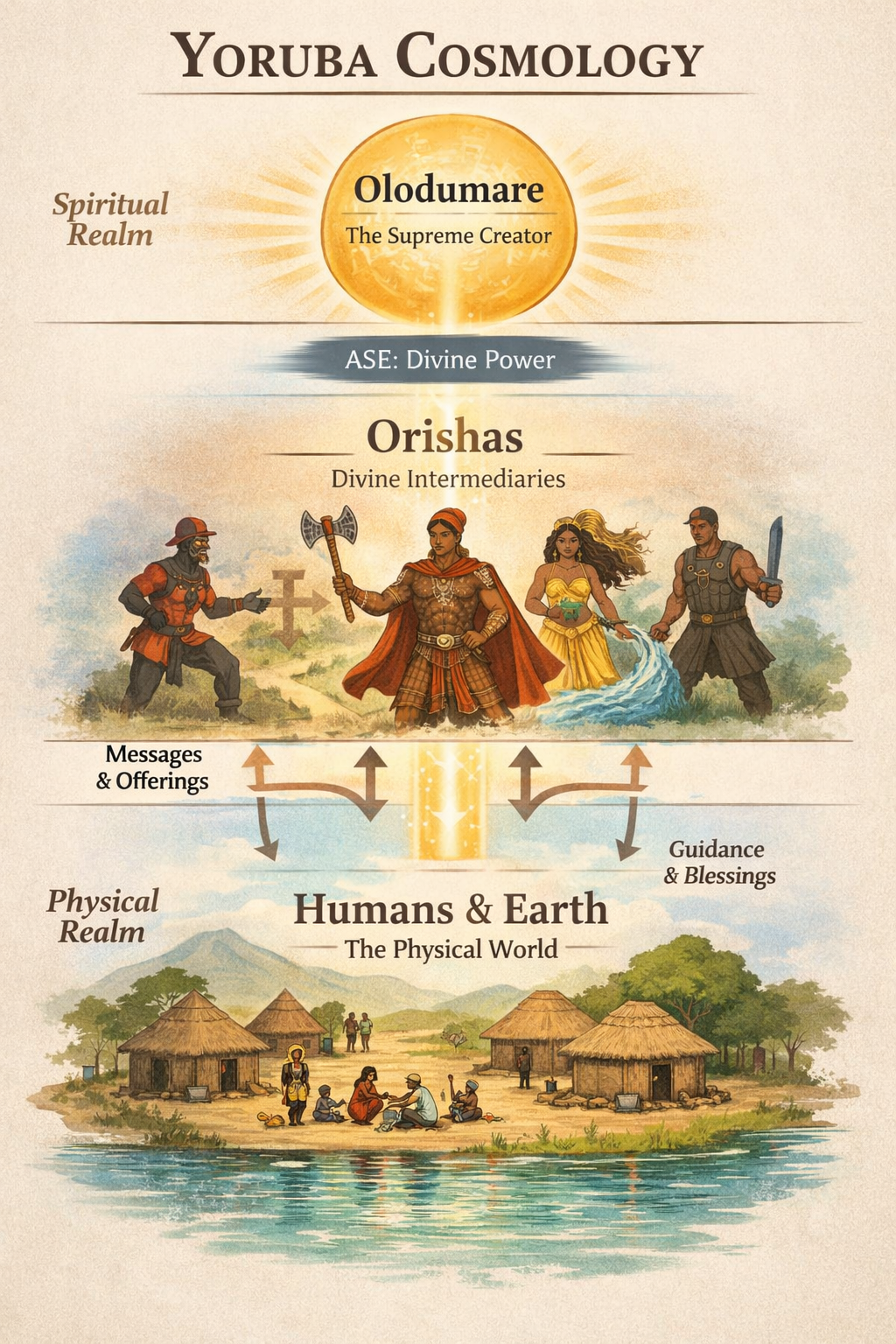
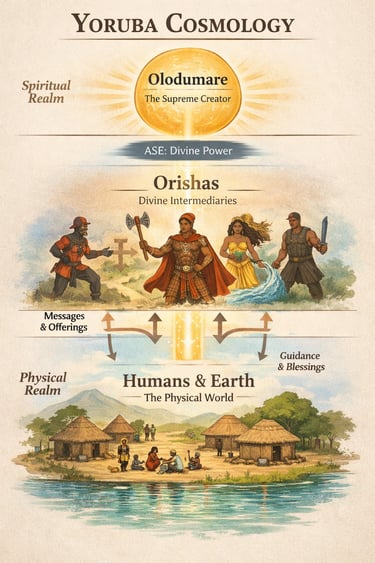
Yoruba mythology is a spiritual and philosophical system originating from the Yoruba people of West Africa. It explains creation, divine order, and human destiny through stories about the supreme deity Olodumare and a network of divine beings called Orishas.
Yoruba mythology developed among the Yoruba ethnic group primarily located in present-day southwestern Nigeria, as well as parts of Benin and Togo. The belief system evolved over centuries through oral storytelling, ritual practice, and sacred texts within the Ifa divination tradition.
Unlike many mythologies that exist mostly as stories, Yoruba mythology operates as a living religious system. Millions of people still practice it today.
At its core are three major components:
Olodumare – the supreme creator
Orishas – divine forces governing aspects of nature and life
Ase (Àṣẹ) – the spiritual power that makes things happen
These ideas shape both religious ceremonies and everyday decisions. In Yoruba thought, the spiritual world and physical world are deeply connected.
The tradition spread globally during the transatlantic slave trade, which carried Yoruba beliefs into the Americas. Today it strongly influences religions such as:
Santería in Cuba
Candomblé in Brazil
Trinidad Orisha religion
Haitian Vodou (which shares related spiritual concepts)
This diaspora helped preserve and adapt Yoruba mythology across continents.
Who Are the Orishas in Yoruba Mythology?
Orishas are divine spiritual beings that act as intermediaries between humans and the supreme creator Olodumare. Each Orisha represents a natural force, moral principle, or aspect of human experience.
The Orishas are the central figures in Yoruba mythology. They function somewhat like both gods and spiritual archetypes, each governing a specific domain of existence.
Some Orishas control natural elements such as rivers or storms. Others represent human skills like ironworking, fertility, or justice.
In Yoruba belief, humans rarely interact directly with Olodumare. Instead, they communicate with the divine through Orishas.
There are traditionally hundreds of Orishas, though only a few dozen are widely worshiped today.
Major Characteristics of Orishas
Orishas share several defining traits:
They possess distinct personalities
Each has specific symbols and colors
Each governs certain natural or social forces
They respond to offerings and rituals
They guide human destiny through spiritual influence
Their stories often function as moral lessons, explaining the consequences of pride, anger, loyalty, and wisdom.
What Are the Most Important Orishas?
The most widely recognized Orishas include Obatala, Ogun, Shango, Oshun, Yemaya, and Eshu. Each represents powerful natural forces and human values within Yoruba cosmology.
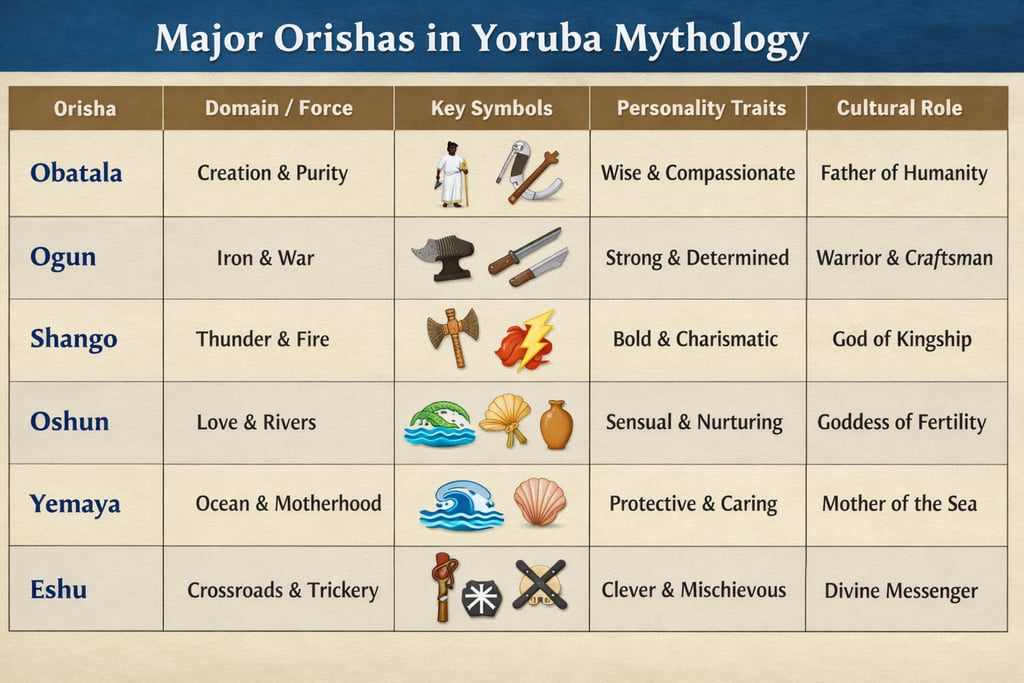
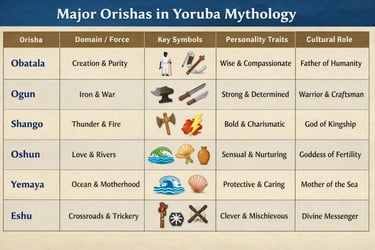
Although many Orishas exist, a smaller group plays dominant roles in mythology and religious practice.
Obatala – The Creator of Humanity
Obatala is often associated with wisdom, purity, and creation.
According to Yoruba creation stories, Olodumare assigned Obatala the task of shaping human bodies from clay. He is considered the father of humanity and is associated with justice and moral clarity.
Obatala is symbolized by the color white, representing peace and spiritual purity.
Ogun – The Orisha of Iron and Technology
Ogun governs metal, warfare, and technological progress.
Historically, blacksmiths, hunters, and warriors honored Ogun. In modern interpretations, he is also linked with engineering, machinery, and industry.
Ogun represents both the creative and destructive power of tools.
Shango – The Orisha of Thunder and Power
Shango is one of the most famous Orishas. He rules thunder, lightning, leadership, and authority.
Legends describe him as a powerful king who later became deified. His stories often explore themes of pride, power, and justice.
Shango's symbol is the double-headed axe, representing balanced authority.
Oshun – The Orisha of Love and Rivers
Oshun governs love, beauty, fertility, and freshwater rivers.
She is known for her compassion and diplomacy. Many myths portray Oshun as the only Orisha able to restore harmony when male Orishas fail.
Her stories emphasize the importance of balance between strength and grace.
Yemaya – The Mother of the Ocean
Yemaya is the Orisha of the sea and motherhood.
She is considered the spiritual mother of many Orishas and protector of women, children, and sailors.
Her symbolism is deeply tied to nurturing, emotional strength, and protection.
Eshu – The Messenger and Trickster
Eshu (also called Elegba or Legba in diaspora traditions) governs communication, crossroads, and fate.
He acts as the messenger between humans and the Orishas. Without Eshu, prayers and rituals cannot reach the divine realm.
His stories often contain paradoxes and trickster elements that teach lessons about perception and consequence.
Across Africa, storytelling often uses clever characters to explain moral lessons and human behavior. Readers familiar with East African trickster tales will notice a similar teaching style in Yoruba mythology.
Trickster figures in East African stories often rely on wit, deception, or humor to reveal deeper truths about pride, greed, or wisdom. Yoruba tradition uses a comparable approach through the Orisha Eshu, whose unpredictable actions expose human mistakes and hidden motives.
Both traditions show how African storytelling uses narrative tension and irony to pass down social rules and spiritual insight.
How Does Yoruba Creation Myth Explain the Universe?
Yoruba creation myths describe how the universe formed when Olodumare sent Orishas to shape the Earth from primordial waters, establishing order between the spiritual realm and the human world.
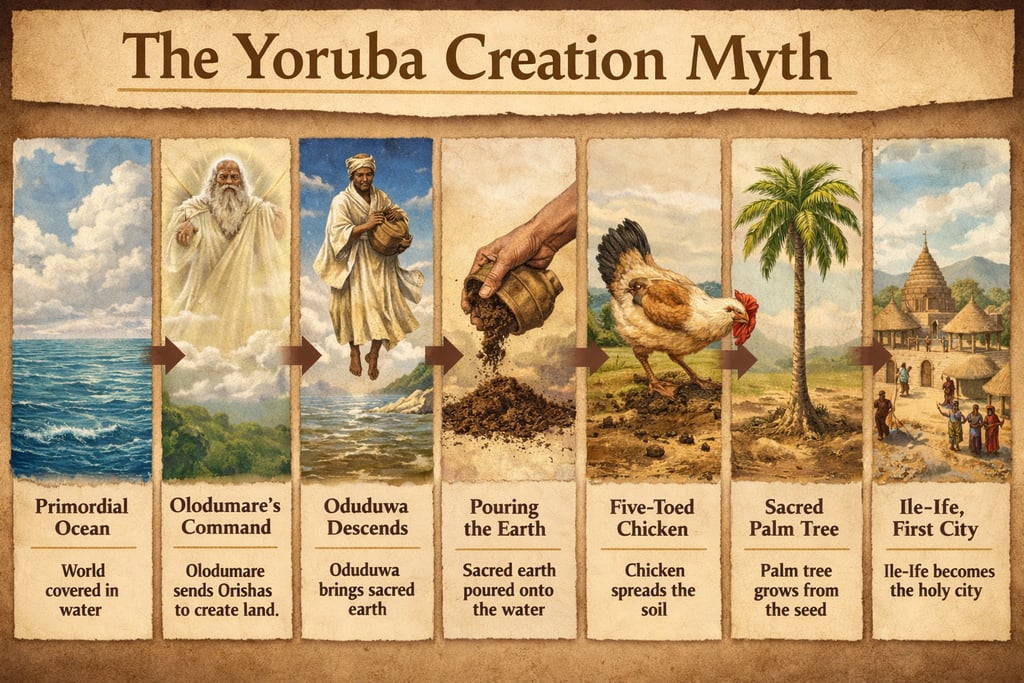
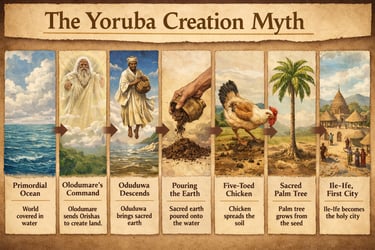
One of the most widely told Yoruba creation stories involves Obatala and Oduduwa.
At the beginning of existence, the world was covered entirely by water. Olodumare instructed the Orishas to create land.
Oduduwa descended from the heavens carrying:
a handful of sacred earth
a five-toed chicken
a palm nut
The earth was poured onto the waters. The chicken scratched and spread the soil, forming land. This place became Ile-Ife, considered the spiritual birthplace of humanity.
Palm seeds later grew into the first sacred tree, symbolizing the expansion of life.
This myth explains more than geography. It also establishes Ile-Ife as the spiritual center of Yoruba civilization.
What Is Ase and Why Does It Matter?
Ase (Àṣẹ) is the sacred life force that allows words, actions, and rituals to produce real effects in the world. It represents divine authority and the power to make change happen.
Ase is one of the most important concepts in Yoruba philosophy.
It is believed that everything contains Ase:
gods
humans
animals
plants
spoken words
When priests perform rituals or when elders speak blessings, they activate Ase.
This idea explains why language and ritual are powerful tools in Yoruba spirituality. Words are not just communication. They are creative forces.
The concept also shapes Yoruba ethics. Actions that respect spiritual balance strengthen Ase. Actions that disrupt harmony weaken it.
How Does Ifa Divination Connect to Yoruba Mythology?
Ifa divination is a sacred knowledge system used to interpret the will of the Orishas and guide human decisions. It preserves thousands of mythological verses that explain spiritual laws and life lessons.
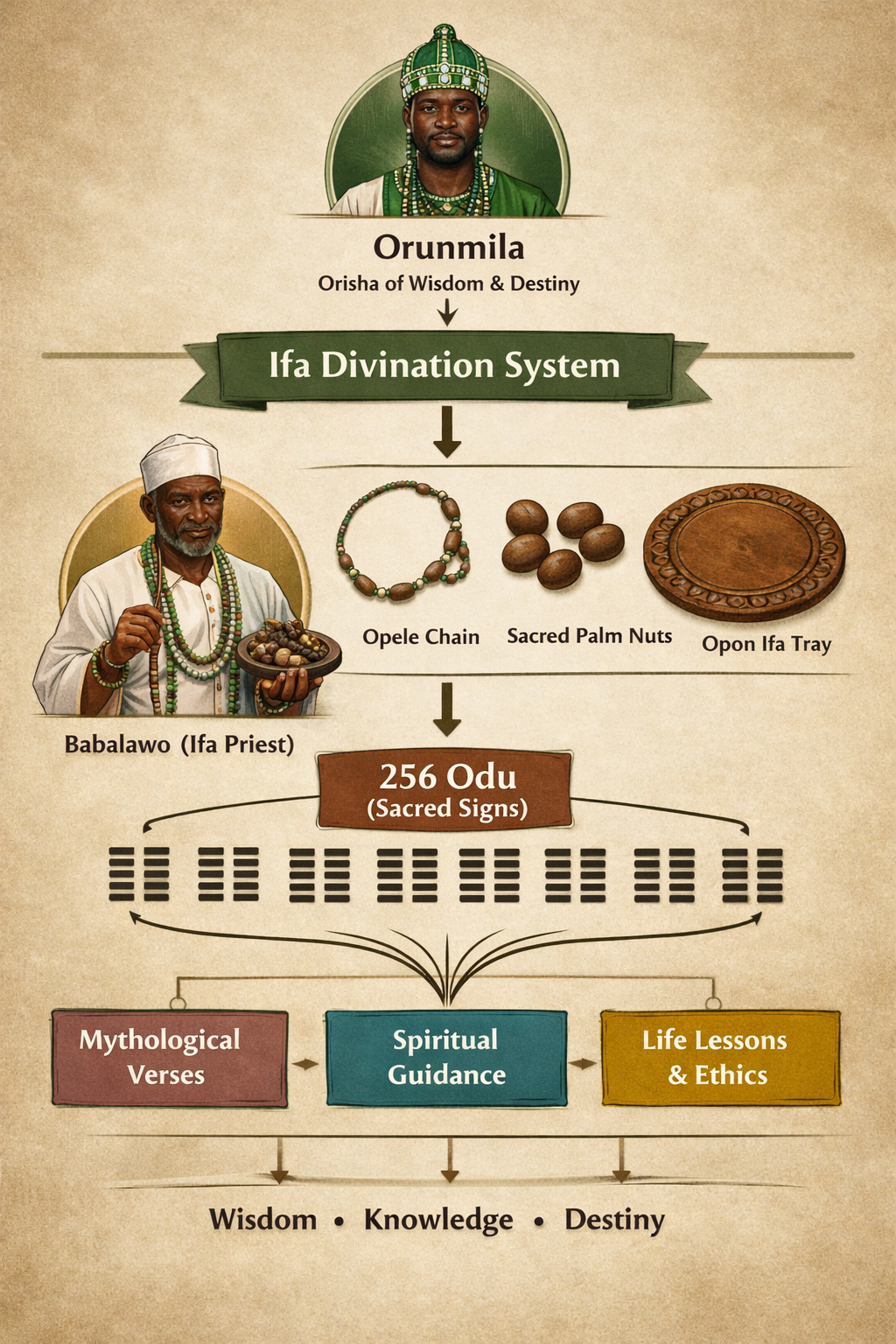
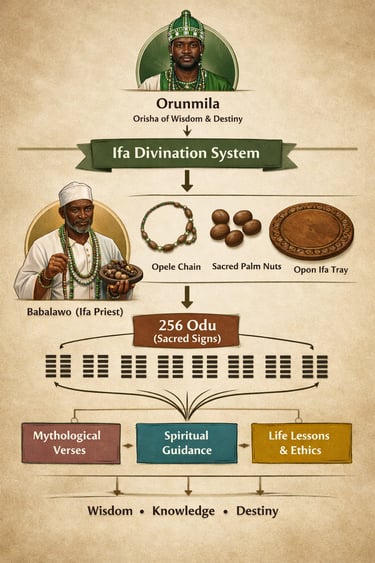
Ifa divination is one of the most sophisticated knowledge systems in African spirituality.
It revolves around the wisdom of Orunmila, the Orisha of knowledge and destiny.
Priests known as Babalawos consult Ifa using tools such as:
sacred palm nuts
divination chains (Opele)
a wooden tray called Opon Ifa
Each divination result corresponds to one of 256 sacred Odu, which contain thousands of verses explaining mythological events and moral teachings.
These verses function as:
spiritual philosophy
historical memory
ethical guidance
cultural storytelling
Ifa is recognized internationally. In 2008 it was added to the UNESCO Intangible Cultural Heritage list.
Why Are Orisha Stories Important for Culture?
Orisha stories transmit cultural knowledge, ethical lessons, and spiritual principles across generations. They shape Yoruba identity, ritual practice, and social values.
In Yoruba society, myths serve multiple purposes.
They explain the natural world, but they also act as social teaching tools.
Stories about Shango warn against abuse of power. Stories about Oshun highlight empathy and diplomacy.
Children grow up hearing these stories during festivals, ceremonies, and family gatherings. Over time, they internalize the moral lessons embedded in them.
This oral tradition keeps Yoruba philosophy alive even without written texts.
How Yoruba Mythology Influenced Global Religions
Yoruba spiritual traditions spread worldwide through the African diaspora and strongly influenced religions in the Caribbean and the Americas.
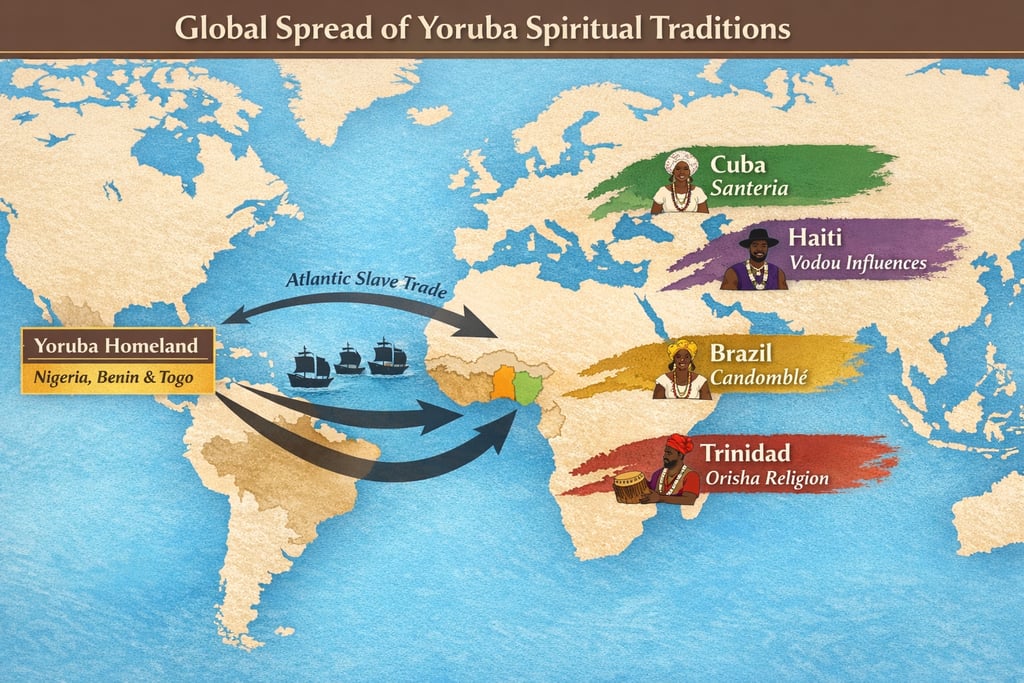
During the Atlantic slave trade, millions of Yoruba people were transported to the Americas.
Despite severe repression, they preserved their spiritual beliefs by blending them with Catholic symbols.
This process created syncretic religions such as:
Santería (Cuba)
Candomblé (Brazil)
Trinidad Orisha
Haitian Vodou
In these traditions, Orishas are often associated with Catholic saints.
For example:
Shango is linked with Saint Barbara
Oshun with Our Lady of Charity
This blending allowed practitioners to preserve their faith under colonial restrictions.
What Mistakes Do People Make When Studying Yoruba Mythology?
Many people misunderstand Yoruba mythology by treating it as simple folklore, ignoring its living religious context, or oversimplifying the roles of Orishas.
Several common misconceptions appear in popular media and online articles.
Treating Orishas as Equivalent to Greek Gods
While comparisons can help beginners, Yoruba Orishas are not identical to classical mythological gods.
They function within an active spiritual system with priests, rituals, and divination.
Ignoring Regional Variation
Different Yoruba communities tell slightly different versions of myths.
These variations are not contradictions. They reflect local traditions and oral storytelling styles.
Oversimplifying the Number of Orishas
Some sources claim there are exactly 401 Orishas. In reality, this number is symbolic. It simply means "many."
The spiritual system evolved across centuries and regions.
How Professionals Study Yoruba Mythology
Scholars and practitioners study Yoruba mythology through oral traditions, Ifa verses, archaeological research, and linguistic analysis of Yoruba language.
Academic study of Yoruba mythology intersects with several fields:
anthropology
religious studies
linguistics
African history
Researchers often analyze Ifa verses, which contain encoded historical memory and philosophical insights.
Ethnographic fieldwork also plays an important role. Scholars work directly with Yoruba priests and communities to understand living traditions.
Prominent researchers include:
Wande Abimbola
Jacob Olupona
Henry Drewal
Their work helped bring Yoruba religion into global academic discussions.
Frequently Asked Questions About Yoruba Mythology
What religion follows Yoruba mythology?
Yoruba mythology forms the foundation of the Yoruba religion, sometimes called the traditional Yoruba faith. It also influences diaspora religions like Santería, Candomblé, and Trinidad Orisha.
How many Orishas exist?
There is no fixed number. Traditional sayings reference 401 Orishas, but the number is symbolic and represents a large spiritual network rather than an exact count.
Is Yoruba mythology still practiced today?
Yes. Millions of people in Nigeria and across the African diaspora continue to practice Yoruba religion and Orisha traditions today.
Who is the supreme god in Yoruba mythology?
The supreme deity is Olodumare (also called Olorun). Olodumare created the universe but typically interacts with humanity through the Orishas.
What language preserves Yoruba myths?
Most myths are preserved in the Yoruba language, especially within the poetic verses of Ifa divination.
Final Thoughts
Yoruba mythology is far more than a collection of ancient stories. It is a living philosophical system that explains creation, morality, and human destiny.
Through the Orishas, Yoruba tradition connects natural forces, human character, and divine power into a unified worldview.
Understanding these stories opens a window into one of the world's most influential spiritual traditions. Their influence stretches from West Africa to the Caribbean, Brazil, and beyond, continuing to shape cultures and religions across the globe.
About The Author
Mubashir Shakoor Godha is a blogger, digital marketer, and SEO specialist based in Pakistan. He started his journey in 2019 on Blogger and has since built and managed multiple websites that rank on Google and AI driven search platforms.
He is also the Founder of MSG Digitals, Top Rated Digital Marketing Agency in Pakistan, where he helps businesses grow through SEO, content strategy, and performance marketing.

usefulservices24@gmail.com
© 2026 Tales of Africa. All rights reserved. Powered by MSGDigitals.com