
First Football Match in Africa History Explained
The first recorded football match in Africa took place in the late 19th century, likely in Egypt or South Africa, organized by British colonists, marking the introduction of association football to the continent.
SPORTS
Godha
3/17/20266 min read
First Football Match in Africa Explained
Football in Africa didn’t begin with packed stadiums or national pride. It started quietly, often on dusty fields near colonial settlements. If you trace its roots, you’ll find a story shaped by empire, migration, and local adaptation.
Let’s break it down properly, from its earliest recorded matches to how it evolved into Africa’s most popular sport.
What Was the First Football Match in Africa?
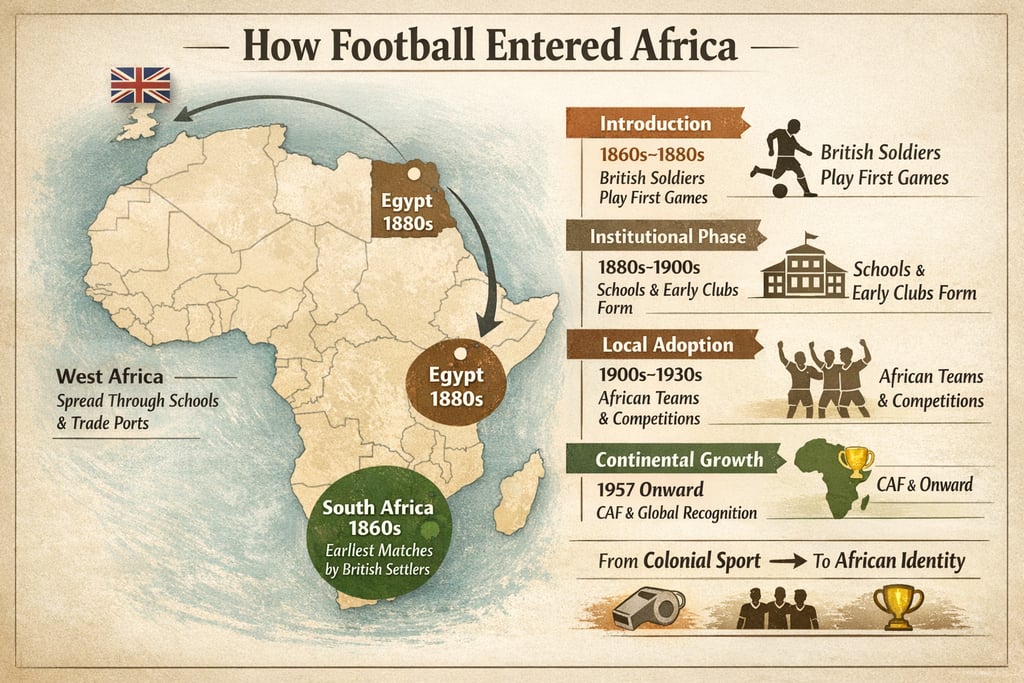
The earliest known football matches in Africa occurred in the 1860s to 1880s, primarily in South Africa and Egypt. These games were organized by British soldiers, sailors, and expatriates who introduced association football to local regions.
Pinpointing the exact first match is difficult because early games were informal and poorly documented. However, historical records strongly suggest that South Africa hosted some of the earliest matches around 1862 in Cape Town.
At the same time, Egypt saw football introduced through British military presence and trade routes via the Suez Canal. These matches were not local competitions at first. They were played among British personnel, often as recreation.
At this stage include:
British Empire: The main force behind global football spread
Association Football (FA rules): Standardized in England in 1863
Colonial Settlements: Entry points for the sport into Africa
These early matches laid the foundation for structured football systems across the continent.
If you look at the first recorded matches in Africa, they make more sense when viewed within the wider timeline of how football developed across the continent.
In my earlier breakdown of football history in Africa, I explored how the game moved from isolated colonial matches into structured leagues, national teams, and continental competitions.
Those early games in places like Cape Town and Alexandria were not just starting points.
They were the first layer of a much larger transformation that shaped how football became deeply rooted in African society.
Why Was Football Introduced to Africa?
Football arrived in Africa through British colonial expansion, where soldiers, traders, and administrators brought the sport as a recreational activity, later influencing local populations and educational institutions.
Football spread globally alongside British influence. Wherever the British went, football followed. Africa was no exception.
In many African regions, British colonial officers used sports to:
Maintain morale among troops
Promote discipline in schools
Encourage social structure aligned with colonial systems
Institutions like missionary schools and colonial academies played a major role. Students were introduced to football as part of their education.
Over time, local communities began adopting the sport. What started as a colonial pastime gradually became a local passion.
You can explore the origins of football rules through the official Football Association to understand how the standardized game influenced Africa.
Where Did the First Organized Matches Take Place?
The earliest organized football matches in Africa were played in South Africa, particularly Cape Town, and later in Egypt, where clubs and structured competitions began forming in the late 19th century.
South Africa is widely recognized as the earliest hub of football activity in Africa. The port city of Cape Town was a key entry point due to maritime trade and military presence.
Important developments include:
1862: Informal matches recorded in Cape Town
1882: Formation of the first football clubs in South Africa
1892: South African Football Association established
Meanwhile, Egypt followed closely, with football gaining traction in cities like Alexandria and Cairo. The Suez Canal made Egypt a strategic location for European influence.
Clubs began forming, and local participation increased. This marked a shift from colonial-only matches to inclusive local competitions.
For historical sports governance context, see FIFA’s official history.
How Did Africans Begin Participating in Football?
Africans initially observed football through colonial institutions but gradually began participating through schools, local clubs, and informal matches, eventually forming their own teams and competitions.
At first, football was exclusive. It was played mainly by Europeans in Africa.
However, this changed through:
Missionary schools
Urban exposure
Labor communities near colonial centers
African players started learning the game by watching and participating informally. Over time, they formed their own teams.
This transition is crucial. It marks the moment football stopped being a colonial import and started becoming an African sport.
By the early 20th century:
African players dominated local teams
Community-based clubs emerged
Football became a cultural expression
This shift laid the groundwork for modern African football identity.
What Role Did South Africa Play in Early African Football?
South Africa played a central role in early African football, hosting some of the continent’s first matches, forming early football associations, and establishing structured competitions before most other African regions.
South Africa is often considered the birthplace of organized football in Africa.
Key milestones:
South African Football Association (1892): One of the oldest globally
Early leagues and competitions
Integration of football into urban culture
However, it’s important to understand the social context. Football development in South Africa was shaped by racial segregation under colonial and later apartheid systems.
Separate leagues existed for:
White players
Black African players
Mixed communities
Despite these divisions, football thrived across all communities. It became a powerful social and political tool.
Today, South Africa remains a major football nation, hosting the 2010 FIFA World Cup, a milestone for the continent.
How Did Egypt Contribute to Early Football Development?
Egypt played a key role in early African football by establishing clubs, organizing competitions, and becoming one of the first African nations to participate in international football events.
Egypt’s football development was closely tied to its geopolitical importance.
Major factors include:
Presence of British forces
Strategic trade location via the Suez Canal
Early urbanization
Egypt formed some of Africa’s earliest football clubs, including Al Ahly SC (1907), which remains one of the most successful clubs globally.
Egypt also became:
One of the founding members of the Confederation of African Football (CAF)
A participant in early international tournaments
You can learn more about CAF through their official site: CAF Online.
Egypt helped transition African football from local play to international competition.
How Did Football Spread Across Africa?
Football spread across Africa through colonial networks, trade routes, educational institutions, and urbanization, gradually becoming embedded in local cultures and evolving into the continent’s most popular sport.
Once introduced, football spread rapidly due to its simplicity and accessibility.
Key drivers of spread:
Railways and trade routes: Connected cities and regions
Schools and missions: Taught structured gameplay
Urban migration: Brought diverse communities together
Unlike many sports, football required minimal equipment. This made it easy to adopt across different economic conditions.
By the early 20th century:
Football was played in West Africa (Nigeria, Ghana)
North Africa (Egypt, Algeria)
East Africa (Kenya, Uganda)
Each region developed its own style, influenced by local culture and playing conditions.
What Makes Early African Football Unique?
Early African football is unique because it blended European rules with local cultural expression, creating distinct playing styles, community-driven teams, and a deep emotional connection to the sport.
Football in Africa didn’t stay “European” for long.
African players adapted the game by:
Emphasizing flair and creativity
Incorporating rhythm and improvisation
Building strong community-based teams
This led to playing styles that are still recognized today, especially in countries like Nigeria, Ghana, and Cameroon.
Football also became more than a sport. It became:
A tool for identity
A form of resistance
A source of unity
These cultural layers make African football deeply meaningful.
How Did Early Matches Influence Modern African Football?
Early football matches in Africa laid the foundation for organized leagues, national teams, and international participation, shaping the continent’s football identity and global influence.
Those early matches might seem small, but their impact is massive.
They led to:
Formation of national football associations
Creation of domestic leagues
Participation in global tournaments
Africa now produces some of the world’s top football talent.
Modern stars like:
Mohamed Salah
Sadio Mané
Samuel Eto’o
All trace their football heritage back to those early foundations.
Without those first matches, African football would not exist as it does today.
What’s Connected to the First Football Match in Africa
Important include the British Empire, South African Football Association, Egyptian football clubs, FIFA, and CAF, all of which played interconnected roles in shaping football’s introduction and growth in Africa.
Understanding the first football match in Africa requires looking at connected.
Here’s how they relate:
British Empire → Introduced football globally
South Africa & Egypt → Early adoption hubs
Football Associations → Structured competitions
FIFA → Global governance
CAF → African football authority
Each played a role in transforming football from a colonial activity into a global African phenomenon.
Frequently Asked Questions
When exactly was the first football match played in Africa?
There is no single confirmed date, but historical records suggest matches were played as early as the 1860s in South Africa. These were informal games organized by British soldiers and settlers.
Which country hosted the first football match in Africa?
South Africa is most commonly recognized as hosting the earliest matches, particularly in Cape Town. Egypt also played a major early role due to British influence and trade connections.
Who introduced football to Africa?
Football was introduced by British colonialists, including soldiers, traders, and administrators. They brought the game as part of their culture and recreational activities.
When did Africans start playing football themselves?
Africans began participating in the late 19th century through schools and local communities. By the early 20th century, African players were forming their own teams and competitions.
Why did football become so popular in Africa?
Football became popular because it is simple, accessible, and adaptable. It requires minimal equipment and quickly became part of local culture and identity.
This story starts with a few informal matches but grows into something much bigger. Today, football in Africa is not just a sport. It is history, identity, and global influence combined.
About The Author
Mubashir Shakoor Godha is a blogger, digital marketer, and SEO specialist based in Pakistan. He started his journey in 2019 on Blogger and has since built and managed multiple websites that rank on Google and AI driven search platforms.
He is also the Founder of MSG Digitals, Top Rated Digital Marketing Agency in Pakistan, where he helps businesses grow through SEO, content strategy, and performance marketing.

usefulservices24@gmail.com
© 2026 Tales of Africa. All rights reserved. Powered by MSGDigitals.com