African Folktales Explained Traditions Meaning and Lessons
African folktales are traditional oral stories passed through generations across African cultures. They teach moral lessons, explain natural events, preserve history, and transmit cultural values through storytelling that combines animals, spirits, humans, and symbolic wisdom.
CULTURE
Godha
2/11/20268 min read
African Folktales Explained Traditions Meaning and Lessons
African folktales form one of the oldest storytelling traditions in human history. For centuries, communities across Africa used stories to teach values, explain the world, and pass cultural identity to the next generation.
These stories are not just entertainment. They act as living archives of wisdom, ethics, survival strategies, and community beliefs. Even today, African folktales influence literature, film, education, and modern storytelling worldwide.
Understanding these tales reveals how storytelling shaped societies long before written language became common.
What Are African Folktales?
African folktales are traditional stories shared orally within African communities. They often involve animals, spirits, tricksters, ancestors, and humans. Their main purpose is to teach moral lessons, explain cultural values, and preserve community knowledge.
For most of African history, storytelling happened orally rather than through written texts. Elders, storytellers, and community leaders would gather children and adults during evenings or community events to tell stories.
These storytelling sessions were more than simple narratives. They functioned as educational systems.
Through folktales, communities taught:
honesty
respect for elders
cooperation
wisdom in decision making
consequences of greed or arrogance
Unlike many modern stories, African folktales rarely focus on a single hero. Instead, they present complex social situations where actions carry consequences.
Many stories use animals as symbolic characters, allowing storytellers to explain human behavior in memorable ways.
For example:
the clever spider
the cunning hare
the powerful lion
the stubborn tortoise
These characters represent different human traits.
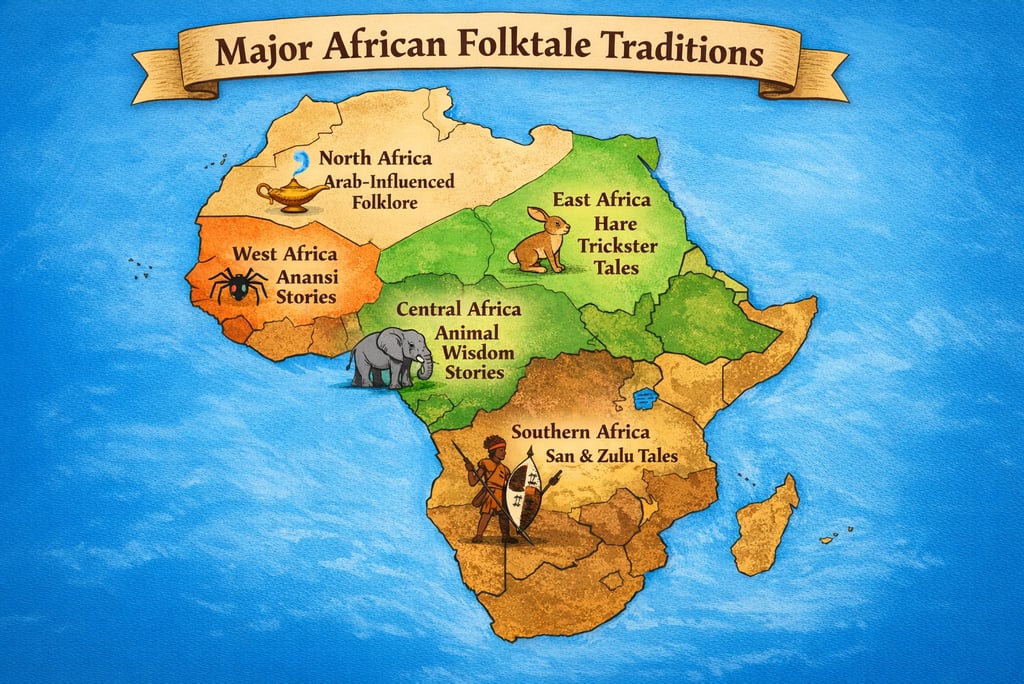
African folktales exist in thousands of variations across regions such as West Africa, East Africa, Central Africa, and Southern Africa. Each region adds local beliefs, geography, and cultural values to its stories.
Why Are African Folktales Important?
African folktales play a critical role in preserving cultural identity, moral education, historical memory, and social values. They help communities teach wisdom and life lessons in ways that are easy to remember and pass on.
In many traditional African societies, formal schooling did not exist for centuries. Storytelling served as the primary method of education.
Folktales helped people learn:
how to behave in society
how to resolve conflicts
how to respect nature
how to understand community rules
Stories also helped young listeners develop critical thinking skills. Many tales include puzzles, riddles, or unexpected outcomes that encourage listeners to reflect.
Another important function is historical memory.
Certain folktales preserve references to past migrations, battles, leaders, and social transformations. These stories allowed communities to remember their past even without written records.
Anthropologists and historians often study folktales to understand ancient cultures.
Organizations such as Encyclopaedia Britannica’s folklore research highlight how oral traditions preserve cultural knowledge across generations.
Folktales also strengthen community bonding. Storytelling events bring people together and reinforce shared beliefs.
What Are the Main Types of African Folktales?
African folktales generally fall into several major categories including trickster tales, animal tales, moral tales, mythological stories, and origin stories. Each type serves a different cultural purpose.


African storytelling traditions are diverse. However, most folktales fit into recognizable categories.
Understanding these types helps reveal how stories function in society.
Trickster Tales
Trickster stories feature clever characters who use intelligence rather than strength to solve problems.
The most famous trickster in African folklore is Anansi the Spider, originating from the Akan people of Ghana.
Anansi stories spread widely through the Atlantic slave trade and influenced Caribbean storytelling traditions.
In trickster tales, the main character often:
deceives stronger animals
solves difficult problems
challenges authority
However, tricksters sometimes suffer consequences when their cleverness becomes greed.
These stories teach listeners the importance of wisdom and restraint.
Animal Tales
Animal tales are among the most common forms of African folktales.
Animals act like humans and represent different personalities or social roles.
Examples include:
the wise tortoise
the arrogant lion
the greedy hyena
the clever hare
These stories often highlight the relationship between intelligence and power.
Many teach that clever thinking can defeat brute strength.
Moral Tales
Moral tales explicitly teach ethical behavior.
They address issues such as:
honesty
generosity
humility
responsibility
A typical moral story may show how a selfish character faces consequences while a kind character receives rewards.
The goal is to guide young listeners toward socially accepted behavior.
Mythological Stories
Mythological folktales explain spiritual beliefs and cosmology.
They may describe:
the creation of the world
interactions between humans and gods
supernatural beings
ancestral spirits
Many African cultures maintain strong connections between spiritual beliefs and storytelling.
These stories often reinforce respect for ancestors and nature.
Origin Stories
Origin stories explain how certain things came to exist.
Examples include stories about:
how animals received their characteristics
how the sun and moon appeared
why certain rivers or mountains exist
These tales helped early societies explain natural phenomena before scientific explanations were available.
Who Are the Famous Characters in African Folktales?
African folktales feature iconic characters such as Anansi the Spider, the Hare, the Tortoise, the Lion, and the Hyena. Each character symbolizes particular human traits and social behaviors.
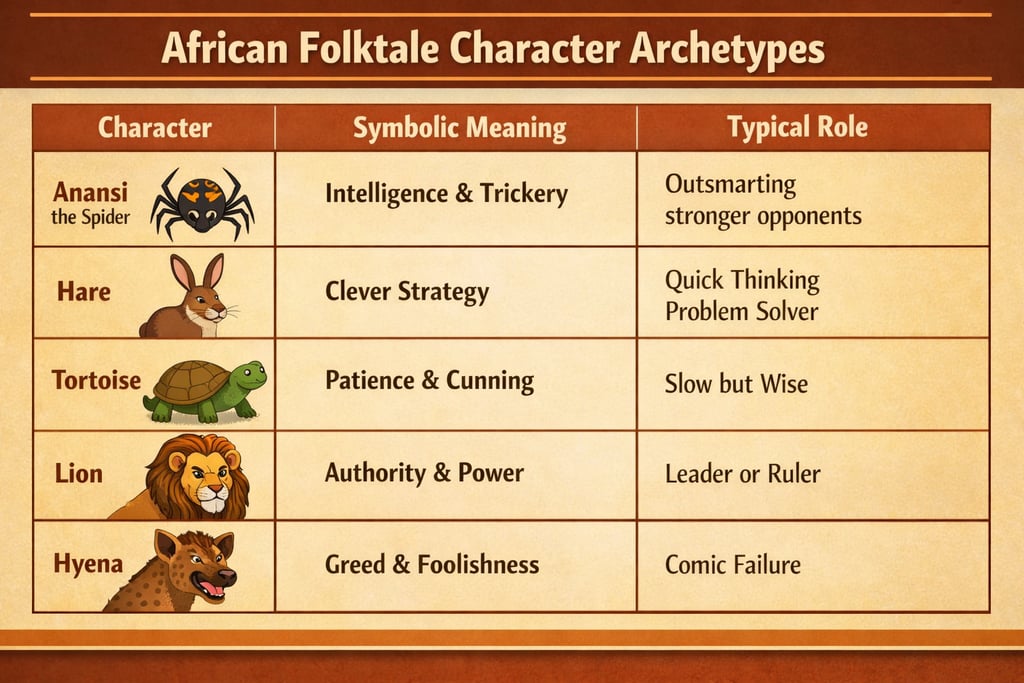
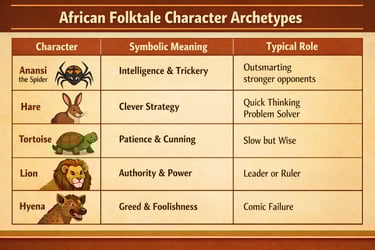
Characters in African folktales act as symbolic representations of human nature.
Rather than focusing on complex individuals, stories use archetypes that listeners quickly recognize.
Anansi the Spider
Anansi is one of the most famous figures in world folklore.
Originating among the Akan people of Ghana, Anansi is a trickster spider who often outsmarts stronger characters.
Anansi stories traveled across the Atlantic through enslaved Africans and became popular in Caribbean and American storytelling traditions.
Today, Anansi appears in books, comics, and modern media.
The Hare
The hare represents cleverness and quick thinking.
In many East African stories, the hare defeats larger animals through strategy.
These tales reinforce the idea that intelligence matters more than physical strength.
The Tortoise
The tortoise appears frequently in West African stories.
It represents patience, cunning, and persistence.
However, the tortoise can also be greedy, leading to humorous or cautionary outcomes.
The Lion
The lion often represents authority, leadership, or power.
Stories sometimes show how even powerful leaders can be misled by clever characters.
This provides subtle commentary on leadership and governance.
The Hyena
Hyenas are typically portrayed as greedy, foolish, or lazy.
Their failures illustrate the consequences of poor judgment or selfish behavior.
How Do African Folktales Teach Moral Lessons?
African folktales teach moral lessons through symbolic storytelling, character consequences, and relatable social situations. Listeners learn values indirectly by observing how characters succeed or fail.
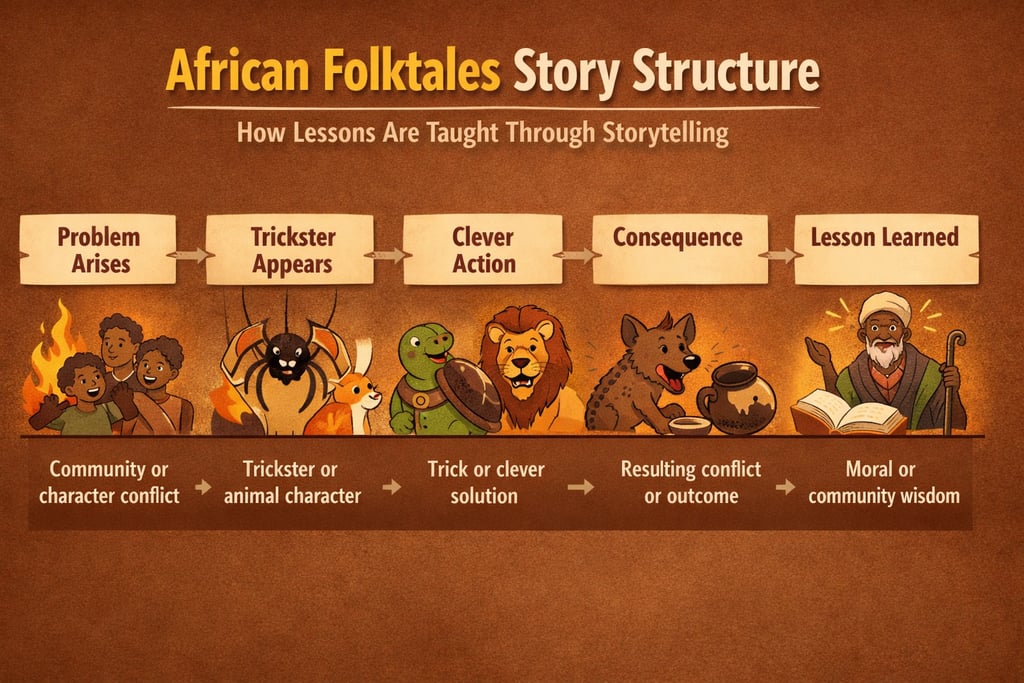
Unlike modern moral education, African folktales rarely state lessons directly.
Instead, they rely on story consequences.
For example:
A greedy character may lose everything.
A kind character may gain unexpected rewards.
A clever character may defeat a stronger opponent.
This indirect approach encourages listeners to reflect and interpret the message themselves.
Professional storytellers also use techniques such as:
repetition
rhythm
audience participation
call and response
These techniques make stories memorable and emotionally engaging.
The moral lessons become easier to remember because they are tied to vivid narratives.
How African Folktales Preserve Cultural Identity
African folktales preserve cultural identity by transmitting language, beliefs, values, and historical memory across generations. They maintain cultural continuity even as societies change.
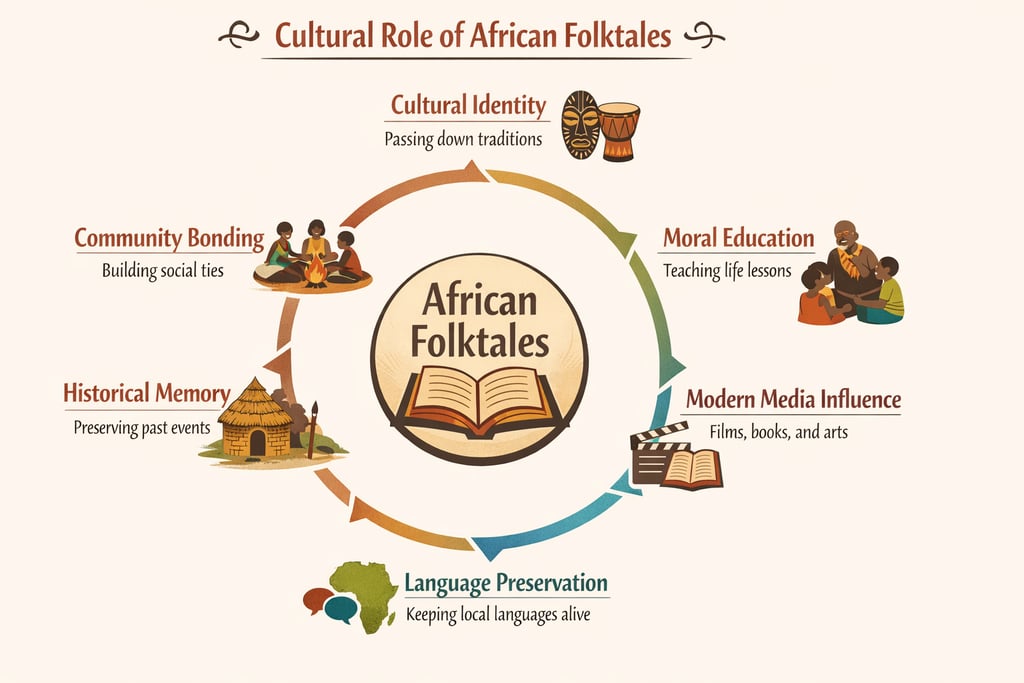
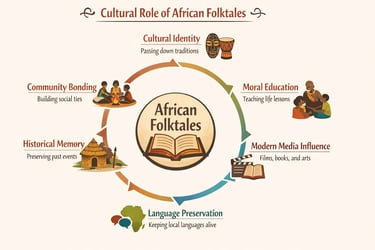
Storytelling is deeply connected to community identity.
Through folktales, communities reinforce shared values and social norms.
For example:
respect for elders
cooperation within families
responsibility to the community
Folktales also preserve indigenous languages.
Many stories rely on linguistic patterns, proverbs, and expressions that are difficult to translate.
When languages disappear, many of these stories disappear as well.
Cultural organizations such as UNESCO’s Intangible Cultural Heritage program emphasize the importance of protecting oral storytelling traditions.
Without preservation efforts, many folktales risk being lost.
How African Folktales Influenced Global Storytelling
African folktales have influenced global literature, children’s stories, theater, and modern media. Many storytelling techniques and characters spread worldwide through cultural exchange and historical migration.
African storytelling traditions shaped many storytelling systems used today.
For example, the trickster archetype appears in many cultures.
Scholars believe these themes spread through trade routes and migration.
The transatlantic slave trade also carried African folktales to the Caribbean and the Americas.
These stories evolved into traditions such as:
Caribbean Anansi stories
African American Brer Rabbit tales
Southern American trickster folklore
Modern writers continue to draw inspiration from African folklore.
Authors like Chinua Achebe and Ngũgĩ wa Thiong’o incorporate traditional storytelling structures into literature.
Contemporary fantasy and children’s literature increasingly explore African folklore themes as well.
Common Mistakes People Make When Studying African Folktales
Many people misunderstand African folktales by assuming they are simple children’s stories, ignoring regional diversity, or interpreting them without cultural context.
One of the biggest misconceptions is that folktales are only for children.
In traditional societies, storytelling sessions included both adults and children. Many stories contain complex social commentary that adults appreciate more deeply.
Another mistake is treating Africa as a single culture.
Africa contains over 50 countries and thousands of ethnic groups, each with unique storytelling traditions.
West African stories differ greatly from those in Ethiopia, Kenya, or South Africa.
Researchers must also avoid interpreting stories purely through Western perspectives.
Certain symbols, animals, or spiritual elements carry meanings that only make sense within their cultural context.
Understanding the cultural background is essential.
Practical Ways African Folktales Are Used Today
African folktales remain relevant today in education, literature, film, cultural preservation, and leadership training. Their lessons continue to shape storytelling and moral education worldwide.
Today, African folktales serve many modern purposes.
Teachers use them to introduce students to global cultures.
Writers use them as inspiration for new stories.
Filmmakers adapt traditional tales into animation and theater.
Businesses and leadership coaches even use folktale lessons to explain strategy, ethics, and leadership principles.
For example, trickster stories often illustrate strategic thinking and adaptability.
Many universities also study African oral traditions as part of anthropology and literature programs.
Understanding African Folktales
Professionals who analyze folklore often examine stories through several lenses.
Cultural Lens
Understanding the cultural beliefs and traditions behind the story.
Symbolic Lens
Analyzing characters as symbols of human traits.
Historical Lens
Studying how stories preserve historical memory.
Social Lens
Observing how stories reflect community values and social rules.
Using these lenses helps researchers uncover deeper meanings within folktales.
Frequently Asked Questions About African Folktales
What is the most famous African folktale?
One of the most famous African folktales involves Anansi the Spider, a trickster character from Ghanaian Akan traditions. These stories spread globally and influenced Caribbean and American folklore.
Are African folktales true stories?
Most African folktales are fictional narratives designed to teach moral lessons or explain cultural beliefs. However, some stories include historical elements that reflect real events or cultural experiences.
Why do African folktales use animals as characters?
Animals allow storytellers to represent human traits in a symbolic way. This makes stories easier to remember and helps listeners understand moral lessons without directly criticizing real people.
How were African folktales passed down?
African folktales were traditionally passed through oral storytelling. Elders and skilled storytellers shared stories during community gatherings, ceremonies, and family evenings.
Are African folktales still relevant today?
Yes. African folktales continue to influence literature, education, and storytelling worldwide. They also remain an important part of cultural preservation and community identity.
What age group are African folktales meant for?
African folktales were traditionally shared with both children and adults. Many stories contain simple lessons for younger listeners while offering deeper meaning for mature audiences.
African folktales remain one of the richest storytelling traditions in the world. They connect past and present, culture and imagination, wisdom and entertainment.
Understanding these stories provides insight not only into African cultures but also into the universal power of storytelling.
About The Author
Mubashir Shakoor Godha is a blogger, digital marketer, and SEO specialist based in Pakistan. He started his journey in 2019 on Blogger and has since built and managed multiple websites that rank on Google and AI driven search platforms.
He is also the Founder of MSG Digitals, Top Rated Digital Marketing Agency in Pakistan, where he helps businesses grow through SEO, content strategy, and performance marketing.

usefulservices24@gmail.com
© 2026 Tales of Africa. All rights reserved. Powered by MSGDigitals.com