
Anansi Stories Explained Origins Meaning and Cultural Impact
Anansi stories are traditional West African folktales about a clever spider trickster who uses intelligence, humor, and deception to overcome stronger opponents. These stories teach moral lessons, preserve cultural identity, and influence storytelling traditions across Africa and the Caribbean.
CULTURESTORIES
Godha
2/12/20268 min read
Anansi Stories Explained
Anansi stories are among the most influential folk narratives in the world. Originating from the Akan people of Ghana, these tales spread across continents through oral tradition and the African diaspora.
Today, Anansi stories are studied by folklorists, historians, educators, and writers because they combine cultural memory, social commentary, and creative storytelling techniques.
This guide explains what Anansi stories are, where they came from, why they matter, and how they continue shaping literature, culture, and education worldwide.
What Are Anansi Stories?
Anansi stories are traditional folktales centered on Anansi, a clever spider character who outwits stronger animals and humans through intelligence and trickery. These stories were originally told by the Akan people of West Africa and later spread throughout the Caribbean and the Americas.
Anansi stories belong to a category of folklore known as trickster tales. Trickster figures appear in many cultures and represent characters who break rules, challenge authority, and reveal hidden truths through humor.
In Akan culture, Anansi is both a spider and a human-like figure. He is clever but flawed, often greedy, selfish, or mischievous. His actions frequently create chaos before resolving into a lesson.
Unlike heroic myths that celebrate strength or bravery, Anansi stories emphasize intelligence over power.
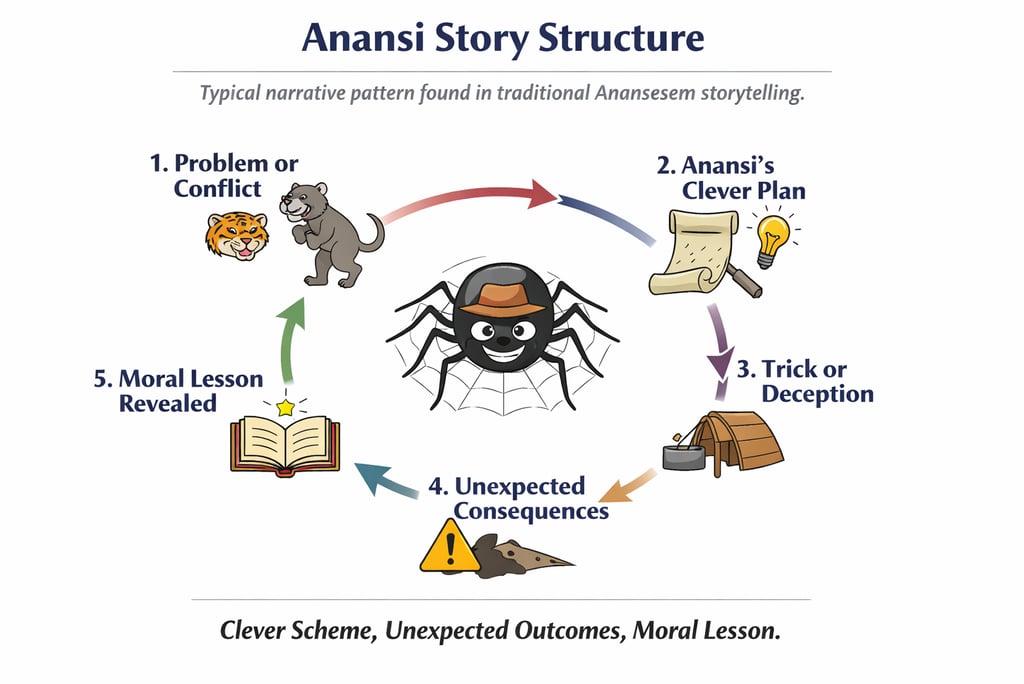
The typical structure includes:
A problem or conflict
Anansi’s clever but risky plan
Unexpected consequences
A lesson about behavior or human nature
These narratives served several purposes:
• entertainment during community gatherings
• moral education for children
• preservation of cultural identity
• subtle social critique
Because they were transmitted orally for centuries, many variations exist across regions.
Where Did Anansi Stories Originate?
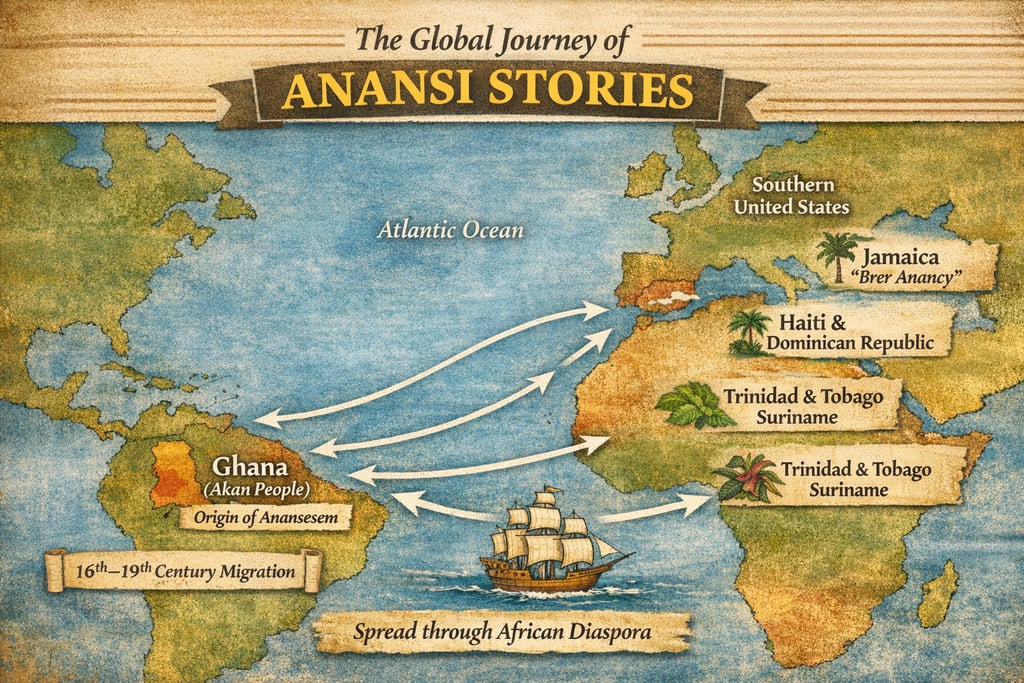
Anansi stories originated among the Akan people of present-day Ghana in West Africa. They were traditionally shared through oral storytelling during communal gatherings and later spread globally through the transatlantic slave trade.
The Akan people developed a rich storytelling tradition known as Anansesem, meaning “spider tales.”
These stories were often told in the evenings after daily work was finished. Storytelling sessions involved participation, rhythm, and audience responses.
Key features of traditional Akan storytelling include:
• call-and-response interaction
• musical elements and chanting
• audience participation
• improvisation by the storyteller
Anansi became the central figure because spiders symbolize patience, creativity, and weaving connections.
When Africans were forcibly transported to the Americas during the transatlantic slave trade, they carried their storytelling traditions with them.
As a result, Anansi stories spread to places such as:
• Jamaica
• Trinidad and Tobago
• Suriname
• Haiti
• the United States (especially the South)
In Jamaica, Anansi became known as "Brer Anancy" or simply "Anancy."
These Caribbean versions preserved African storytelling traditions while adapting them to new social realities.
Why Is Anansi Often Portrayed as a Trickster?
Anansi is portrayed as a trickster because trickster characters challenge authority, expose social flaws, and show how intelligence can overcome power. In many cultures, tricksters reveal truths about human behavior through humor and mischief.
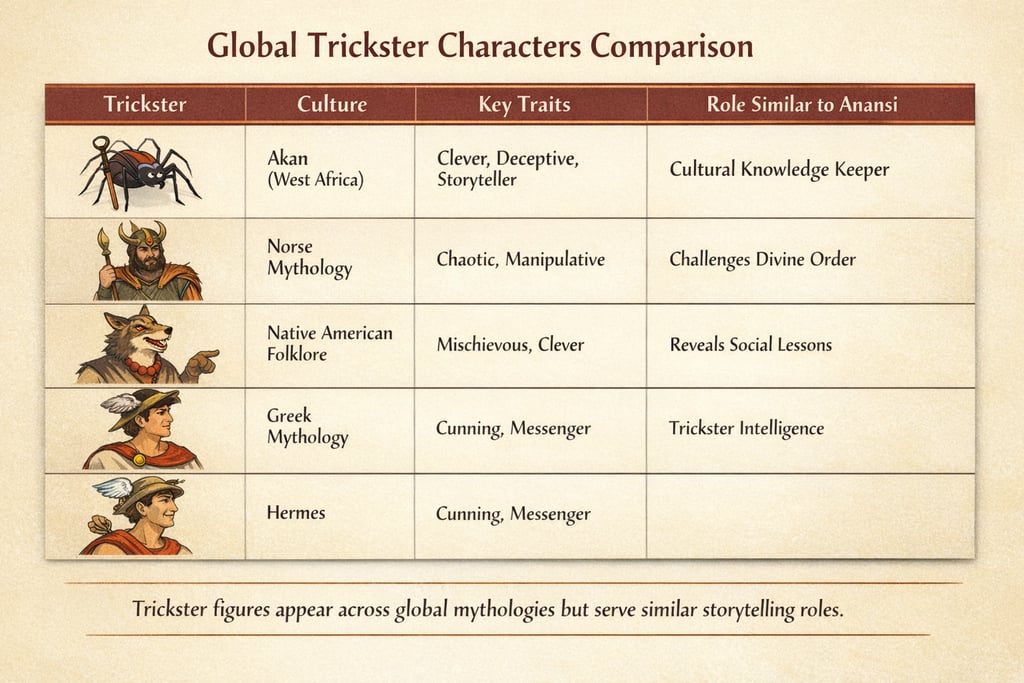
Trickster figures appear across global mythologies.
Examples include:
• Loki in Norse mythology
• Coyote in Native American stories
• Hermes in Greek mythology
Anansi fits within this broader narrative tradition.
However, the trickster role held particular importance for enslaved African communities.
Anansi’s cleverness symbolized psychological resistance against oppressive systems.
In many stories:
• stronger animals represent authority figures
• Anansi represents the oppressed individual
• trickery becomes a survival strategy
This dynamic allowed storytellers to express resistance indirectly without openly confronting power structures.
Folklorists note that trickster tales often emerge in societies facing inequality or hardship because they allow people to imagine victory through intelligence rather than force.
What Moral Lessons Do Anansi Stories Teach?
Anansi stories teach moral lessons about greed, wisdom, cooperation, honesty, and the consequences of selfish behavior. Although Anansi sometimes succeeds through trickery, his actions often backfire, reinforcing ethical values.
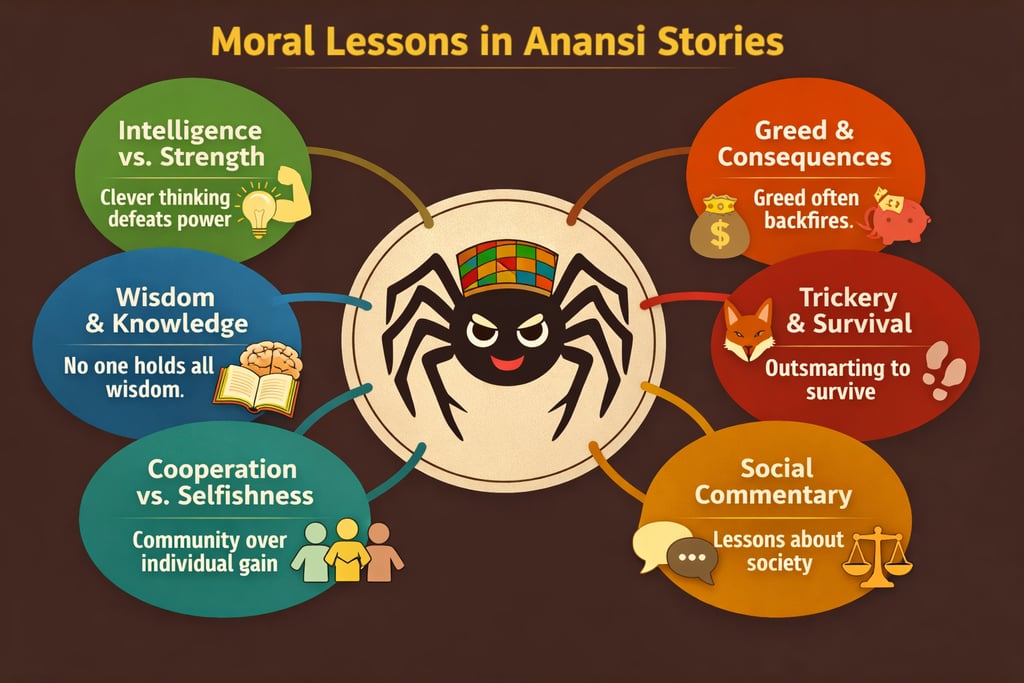
Anansi stories often follow a pattern where the character’s schemes initially appear successful but eventually lead to unexpected consequences.
This storytelling technique allows audiences to explore ethical dilemmas without strict moral preaching.
Common lessons include:
Intelligence Is Valuable but Must Be Used Wisely
Anansi often wins through clever thinking. However, when he becomes overly greedy, his plans collapse.
Greed Leads to Trouble
Many stories show Anansi attempting to keep all the rewards for himself, only to lose everything.
Cooperation Is Stronger Than Individual Gain
Some tales contrast Anansi’s selfish behavior with the cooperation of other characters.
Actions Have Consequences
Even when trickery succeeds temporarily, long-term outcomes often reveal deeper truths.
This layered storytelling made Anansi tales powerful teaching tools for children and adults alike.
Anansi stories are not the only African folktales built around clever characters and moral insight. Similar narrative patterns appear in Southern African traditions as well.
In many Zulu folktales, the lesson often hides beneath humor, animal behavior, or unexpected outcomes. The surface story may feel simple, yet it usually reflects deeper ideas about wisdom, patience, and community responsibility.
This layered storytelling approach shows how different African cultures used folktales to teach values while keeping listeners engaged.
How Did Anansi Stories Spread Across the Caribbean?
Anansi stories spread across the Caribbean through enslaved Africans who preserved their oral traditions despite displacement. These stories adapted to local languages, cultures, and historical conditions while maintaining their core themes.
During the transatlantic slave trade between the 16th and 19th centuries, millions of Africans were forcibly transported to the Americas.
Despite brutal conditions, enslaved communities preserved cultural traditions through storytelling, music, and religion.
Anansi stories became particularly popular in Jamaica.
In Jamaican folklore, Anansi interacts with characters such as:
• Tiger
• Monkey
• Goat
• Rabbit
Tiger often represents authority or brute strength, while Anansi represents cunning survival.
These stories helped maintain African cultural identity and provided emotional resilience during periods of oppression.
Today, Caribbean literature and theater still incorporate Anansi characters.
What Are the Most Famous Anansi Stories?
Some of the most famous Anansi stories include “Anansi and the Pot of Wisdom,” “Anansi and the Sky God,” and “How Anansi Got Stories from the Sky God.” These tales explain how stories, wisdom, or cultural knowledge entered the world.
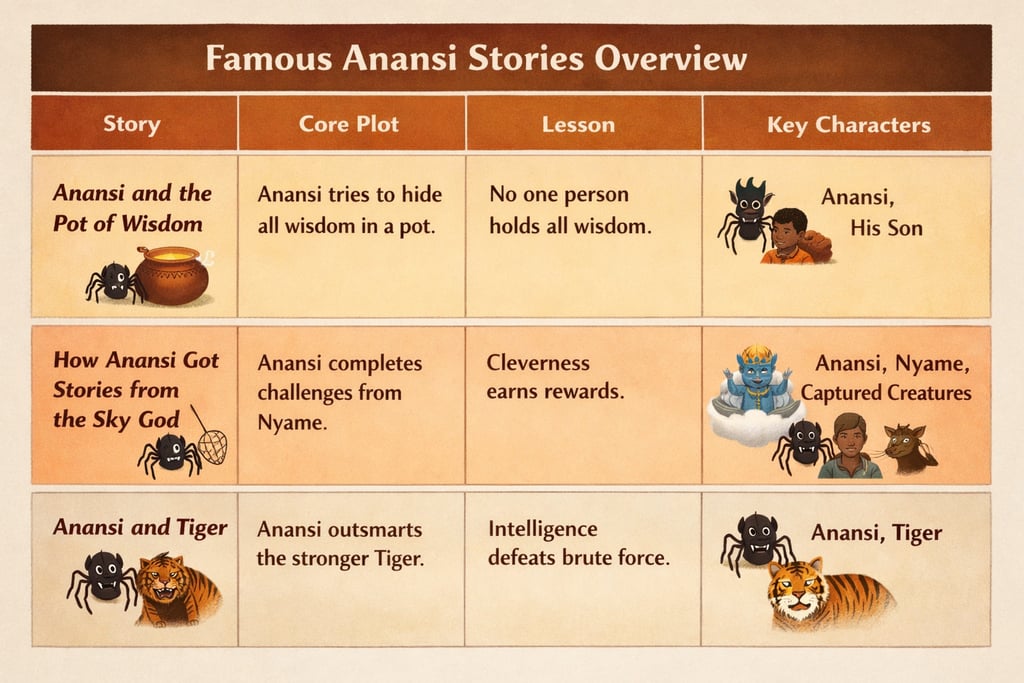
Several Anansi stories became widely known because they explain cultural origins.
Anansi and the Pot of Wisdom
In this tale, Anansi gathers all the wisdom in the world inside a pot.
He plans to hide it in a tree so no one else can access it.
However, his son suggests a simpler solution, revealing that Anansi himself does not possess all wisdom.
The pot eventually breaks, spreading wisdom across humanity.
How Anansi Got Stories from the Sky God
This origin story explains how storytelling began.
Anansi bargains with the Sky God Nyame to obtain all the stories in the world.
Nyame demands that Anansi capture several powerful creatures as payment.
Through clever tricks, Anansi succeeds and becomes the keeper of stories.
This tale explains why storytelling itself is sometimes called Anansesem.
How Do Anansi Stories Influence Modern Literature?
Anansi stories influence modern literature, children’s books, and fantasy writing by shaping trickster characters and narrative structures. Many contemporary authors reinterpret Anansi within new cultural and literary contexts.
Anansi remains an influential literary figure.
Modern writers often draw inspiration from African folklore when developing trickster characters.
One notable example is author Neil Gaiman, who incorporated Anansi mythology into the novel Anansi Boys.
Children’s authors also adapt Anansi stories to introduce young readers to African cultural traditions.
Books by scholars such as Gerald McDermott and Eric A. Kimmel help preserve these narratives for new generations.
Modern adaptations often maintain the humor and cleverness of the original tales while simplifying complex cultural themes for younger audiences.
How Are Anansi Stories Used in Education?
Educators use Anansi stories to teach cultural history, storytelling techniques, moral reasoning, and creative writing. These narratives provide engaging examples of narrative structure and cross-cultural folklore traditions.
Teachers frequently include Anansi stories in literature and social studies classes.
These stories offer several educational advantages.
Cultural Awareness
Students learn about African and Caribbean traditions often overlooked in Western curricula.
Narrative Structure
Anansi tales demonstrate key storytelling elements:
• character motivation
• conflict
• resolution
• moral outcomes
Creative Thinking
Because Anansi solves problems through unconventional strategies, students can analyze different approaches to problem solving.
Comparative Folklore
Teachers often compare Anansi stories with other trickster traditions.
For example:
• Native American Coyote tales
• European Reynard the Fox stories
• Japanese Kitsune legends
This comparison helps students understand how storytelling reflects cultural values.
What Storytelling Techniques Make Anansi Tales Unique?
Anansi stories use humor, exaggeration, repetition, audience interaction, and clever reversals. These storytelling techniques make the narratives memorable and easy to transmit through oral tradition.
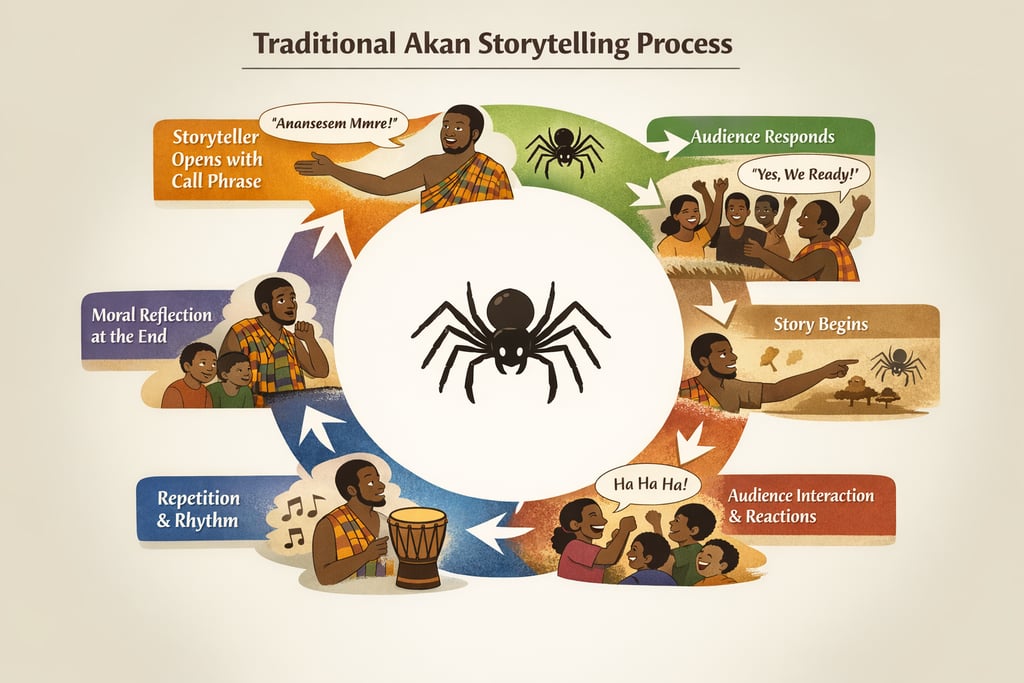
Traditional storytellers rely on techniques designed for live audiences.
Call and Response
Storytellers begin with a phrase that invites audience participation.
Repetition
Important lines or actions repeat to reinforce key moments.
Humor and Irony
Anansi often believes he has outsmarted everyone, only for events to reverse unexpectedly.
Simple but Symbolic Characters
Animals represent personality traits.
Examples include:
• Tiger representing strength
• Rabbit representing quick thinking
• Goat representing stubbornness
These storytelling strategies allow complex ideas to be communicated in simple, engaging ways.
What Mistakes Do People Make When Interpreting Anansi Stories?
Many readers mistakenly view Anansi stories as simple children’s tales. In reality, these narratives contain complex cultural symbolism, social commentary, and historical significance connected to African and Caribbean identity.
Several misconceptions frequently appear in modern interpretations.
Oversimplifying the Stories
Many retellings remove the deeper social meanings embedded in traditional versions.
Ignoring Cultural Context
Anansi stories are closely tied to Akan cosmology and community values.
Treating Trickery as Pure Comedy
In historical contexts, trickery represented survival strategies during oppression.
Removing Community Participation
Modern written versions sometimes eliminate the interactive storytelling elements that made these stories powerful.
Understanding these factors helps readers appreciate Anansi stories as serious cultural literature rather than simple folklore.
Why Do Anansi Stories Still Matter Today?
Anansi stories remain relevant because they preserve cultural identity, teach critical thinking, and demonstrate how storytelling can address social challenges through humor and creativity.
Anansi continues to resonate across cultures because the character represents universal human experiences.
People relate to the idea of overcoming stronger forces through intelligence.
These stories also play an important role in preserving African heritage.
Museums, universities, and cultural organizations study Anansi tales within broader research on African literature and oral traditions.
Today, Anansi appears in:
• children’s books
• theater performances
• animated storytelling
• academic folklore research
This enduring influence shows the power of storytelling to travel across centuries and continents.
Frequently Asked Questions About Anansi Stories
Who created Anansi stories?
Anansi stories were created by the Akan people of West Africa, particularly in present-day Ghana. These stories developed through oral tradition rather than a single author and evolved over centuries of storytelling.
Is Anansi a spider or a human?
Anansi is typically portrayed as a spider, but many stories describe him with human characteristics. In some versions he shifts between spider form and human form, symbolizing both natural and human traits.
Why are Anansi stories important in Caribbean culture?
Anansi stories became central to Caribbean folklore because enslaved Africans preserved them as cultural memory. The stories helped maintain African identity and provided symbolic resistance against oppression.
Are Anansi stories only for children?
No. While many versions are adapted for children, traditional Anansi stories often contain complex themes about power, greed, social inequality, and survival.
What does Anansi symbolize?
Anansi symbolizes intelligence, creativity, survival, and the ability to challenge authority. In many interpretations, he represents the power of wit over strength.
Where can you find original Anansi stories today?
Original versions can be found in folklore collections, academic studies, and cultural archives. Universities and organizations studying African oral traditions preserve many of these narratives.
Anansi stories represent far more than simple folktales. They are a powerful storytelling tradition that connects African heritage, Caribbean culture, and global literature through humor, wisdom, and creativity.
By understanding these stories, you gain insight into how communities preserve history, express identity, and share knowledge across generations.
About The Author
Mubashir Shakoor Godha is a blogger, digital marketer, and SEO specialist based in Pakistan. He started his journey in 2019 on Blogger and has since built and managed multiple websites that rank on Google and AI driven search platforms.
He is also the Founder of MSG Digitals, Top Rated Digital Marketing Agency in Pakistan, where he helps businesses grow through SEO, content strategy, and performance marketing.

usefulservices24@gmail.com
© 2026 Tales of Africa. All rights reserved. Powered by MSGDigitals.com