African Countries Guide 2026
Africa has 54 recognized countries spread across five major regions: North, West, Central, East, and Southern Africa. Each country has unique cultures, languages, economies, and political systems that shape the continent’s global influence.
ENVIRONMENT
Godha
2/19/20268 min read
African Countries Guide
Africa is the world’s second-largest continent and home to more than 1.4 billion people. Despite being frequently discussed as a single place, Africa is actually made up of dozens of diverse countries with different histories, economies, and cultures.
Understanding African countries requires looking at geography, politics, economics, development patterns, and regional cooperation. This guide explains how African nations are structured, how they differ, and why they matter in global markets, travel, trade, and international relations.
What Are African Countries?
African countries are sovereign nations located on the African continent. The continent contains 54 internationally recognized countries, each with its own government, borders, economy, and cultural identity.
Africa’s political borders largely emerged during the 19th and 20th centuries following European colonization and later independence movements. Many African countries gained independence between the 1950s and 1970s.
Today, these countries operate independently but often cooperate through regional and continental organizations such as the African Union (AU).
Africa’s diversity is extraordinary.
Across the continent there are:
more than 2,000 languages
hundreds of ethnic groups
major global religions including Islam and Christianity
growing economies and large urban centers
Countries vary dramatically in population, size, and economic power.
For example:
Nigeria has over 220 million people.
Seychelles has fewer than 100,000 residents.
Algeria is Africa’s largest country by land area.
South Africa has one of the continent’s most industrialized economies.
Understanding African countries requires exploring how geography, colonial history, and economic development shaped modern nations.
How Many Countries Are in Africa?
Africa has 54 internationally recognized sovereign states. These countries are members of the United Nations and the African Union.
The number 54 reflects the current internationally accepted count of African nations. However, geopolitical complexities sometimes lead to confusion.
For example:
Western Sahara is disputed between Morocco and the Sahrawi Arab Democratic Republic.
Somaliland operates as a de facto state but lacks broad international recognition.
The African Union includes 55 members because it recognizes the Sahrawi Arab Democratic Republic.
Despite these complexities, the commonly accepted number used in international statistics and global databases remains 54 African countries.
What Are the Five Regions of Africa?
Africa is commonly divided into five geographic regions: North Africa, West Africa, Central Africa, East Africa, and Southern Africa. These regions help organize economic data, political alliances, and development policies.
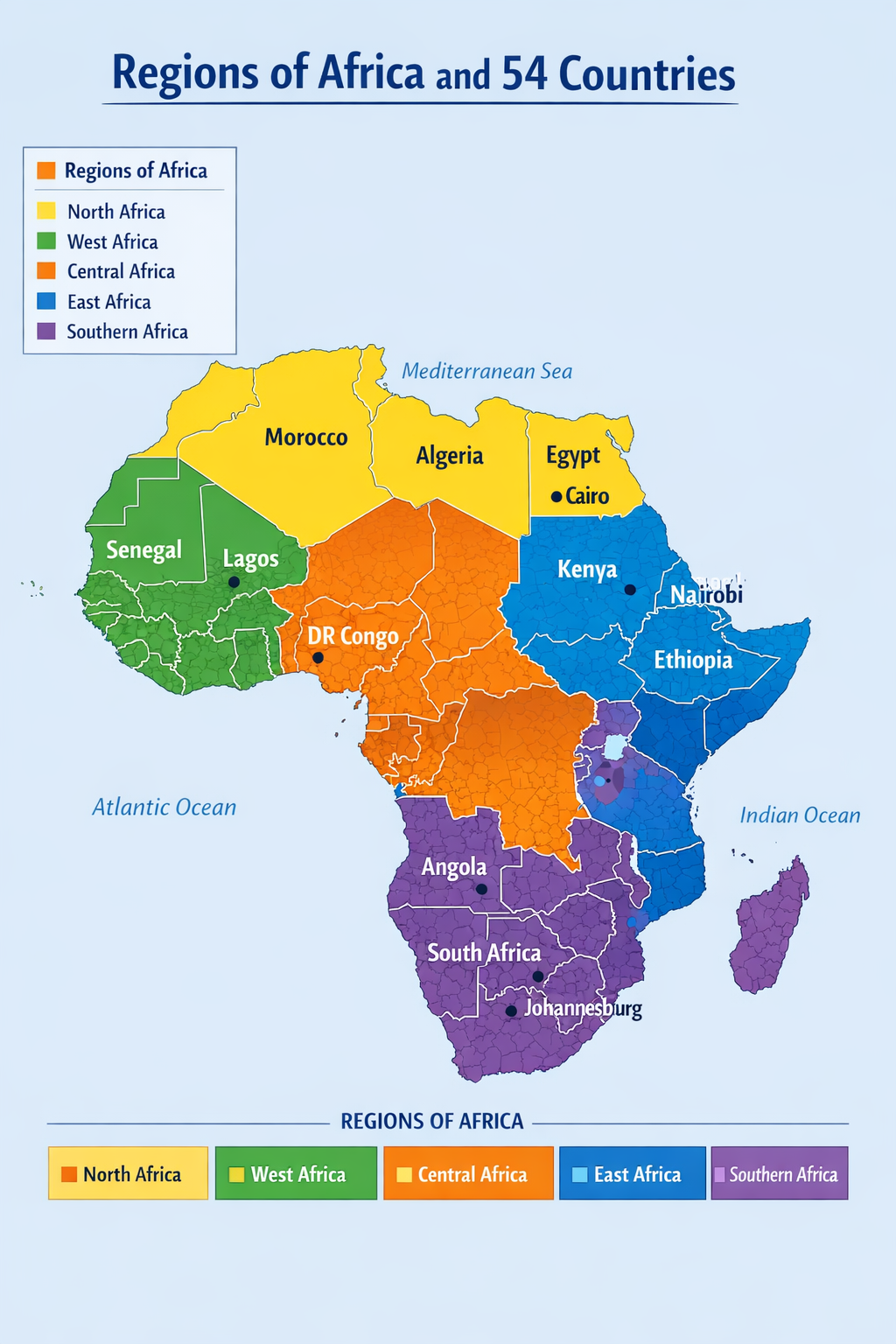
Regional grouping allows analysts, investors, and researchers to understand shared challenges and opportunities across neighboring countries.
The United Nations geoscheme uses this five-region model.
North Africa
Countries in North Africa include:
Algeria
Egypt
Libya
Morocco
Sudan
Tunisia
This region connects Africa with the Middle East and Europe. Arabic language and Islamic culture strongly influence the area.
The economies here often depend on energy exports, tourism, and agriculture.
West Africa
West Africa contains some of the continent’s fastest growing economies.
Countries include:
Nigeria
Ghana
Senegal
Ivory Coast
Mali
Niger
Burkina Faso
Sierra Leone
Liberia
Benin
Togo
Guinea
Guinea-Bissau
Cape Verde
Gambia
Nigeria is the region’s economic giant due to its population and oil sector.
The regional economic bloc ECOWAS plays a major role in trade integration and peacekeeping.
Central Africa
Central Africa is rich in natural resources but faces governance and infrastructure challenges.
Countries include:
Democratic Republic of Congo
Republic of Congo
Cameroon
Central African Republic
Chad
Gabon
Equatorial Guinea
São Tomé and Príncipe
The Democratic Republic of Congo contains vast mineral reserves essential for global technology supply chains.
East Africa
East Africa is known for tourism, wildlife reserves, and emerging technology ecosystems.
Countries include:
Kenya
Tanzania
Uganda
Rwanda
Burundi
Ethiopia
Somalia
Eritrea
South Sudan
Djibouti
Seychelles
Comoros
The East African Community (EAC) aims to create a regional common market and eventually a monetary union.
Kenya has become a technology hub, especially in mobile payments and fintech.
Southern Africa
Southern Africa includes some of the continent’s most industrialized economies.
Countries include:
South Africa
Botswana
Namibia
Zimbabwe
Zambia
Mozambique
Malawi
Angola
Lesotho
Eswatini
Madagascar
Mauritius
The Southern African Development Community (SADC) promotes regional economic cooperation.
Countries like Botswana and Mauritius are often cited for stable governance and strong economic planning.
What Makes African Countries Economically Unique?
African countries are economically diverse, ranging from resource-based economies to rapidly growing service and technology markets.
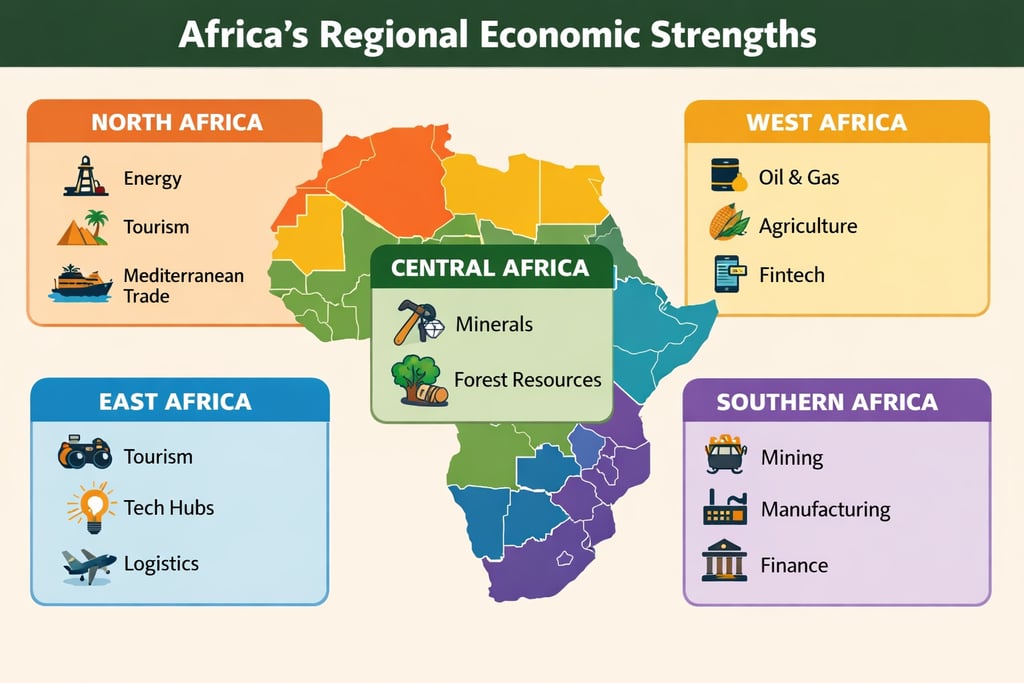
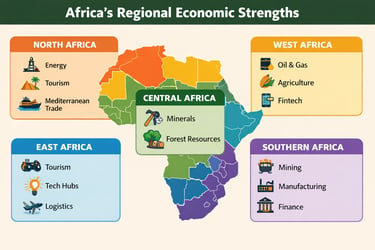
Many African economies historically depended on exporting raw materials such as oil, minerals, and agricultural commodities.
Examples include:
Oil in Nigeria and Angola
Diamonds in Botswana
Copper in Zambia
Cobalt in the Democratic Republic of Congo
However, economic transformation is accelerating.
Several African countries are shifting toward:
digital finance
renewable energy
manufacturing
regional trade
The African Continental Free Trade Area (AfCFTA) aims to create the world’s largest free trade area by number of participating countries.
You can learn more at the African Continental Free Trade Area initiative.
AfCFTA reduces trade barriers between African countries and encourages local manufacturing rather than exporting raw resources.
This shift could reshape Africa’s economic landscape over the next two decades.
Why Are African Countries Important in Global Trade?
African countries hold strategic importance because they supply critical natural resources, emerging consumer markets, and rapidly growing urban populations.
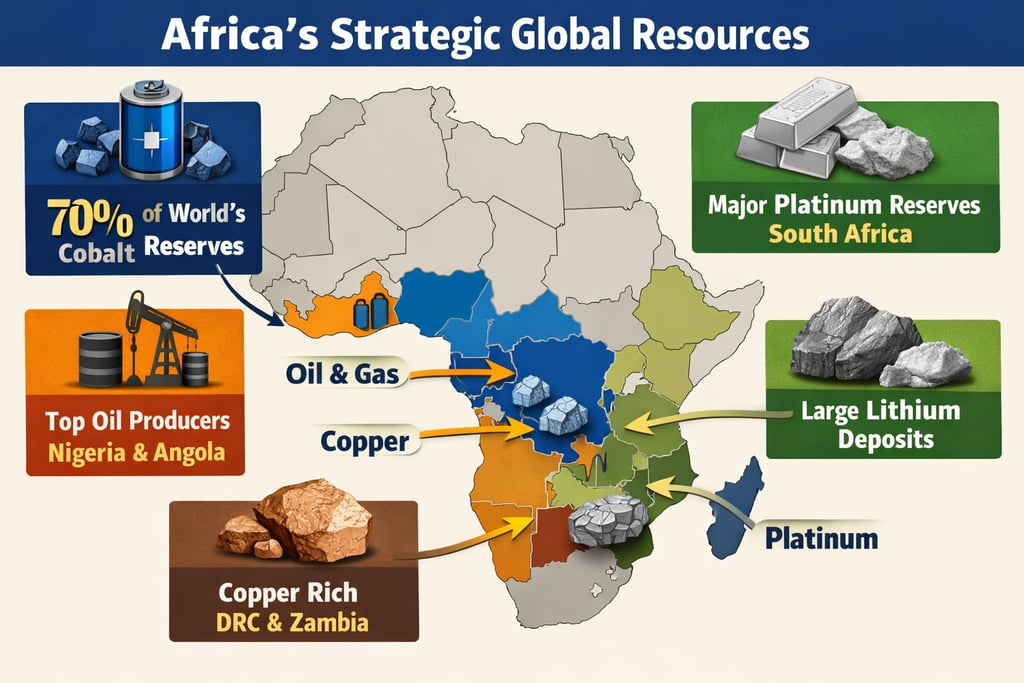
Africa contains significant shares of global mineral reserves.
Examples include:
70% of the world’s cobalt reserves
large platinum reserves in South Africa
major lithium deposits for electric vehicle batteries
These materials are essential for renewable energy technology and electronics manufacturing.
Beyond resources, Africa’s demographic growth also matters.
The continent is expected to reach 2.5 billion people by 2050.
That population growth creates one of the world’s largest future consumer markets.
Investors increasingly view Africa as a long-term economic opportunity rather than just a resource supplier.
How Do Languages and Cultures Shape African Countries?
African countries contain immense cultural diversity, with over 2,000 languages and hundreds of ethnic groups influencing politics, identity, and national development.
Language diversity across Africa is unmatched globally.
Major language families include:
Afro-Asiatic
Niger-Congo
Nilo-Saharan
Khoisan
Many countries use colonial languages such as English, French, or Portuguese as official administrative languages.
This choice helps manage multilingual populations.
Examples include:
English in Kenya, Nigeria, and South Africa
French in Senegal and Ivory Coast
Portuguese in Angola and Mozambique
However, local languages remain essential in daily life.
Cultural traditions also shape national identity.
For instance:
Ethiopia maintains ancient Orthodox Christian traditions
Morocco blends Arab, Berber, and Mediterranean influences
Ghana emphasizes strong traditional chieftaincy institutions
These cultural differences influence governance, education systems, and business practices.
What Are the Most Influential African Countries?
Several African countries stand out for their economic size, political influence, or regional leadership.
Influence in Africa often comes from a combination of population size, economic output, and diplomatic leadership.
Nigeria
Nigeria is Africa’s most populous country and one of its largest economies.
Its oil sector and growing entertainment industry make it a regional powerhouse.
South Africa
South Africa has one of the continent’s most advanced financial systems and infrastructure networks.
The country plays a major role in global diplomacy through organizations like BRICS.
Egypt
Egypt’s strategic location near the Suez Canal makes it vital for global shipping and international trade.
Kenya
Kenya has become East Africa’s technology hub, particularly in mobile banking innovations such as M-Pesa.
Ethiopia
Ethiopia is one of Africa’s fastest growing economies and a key diplomatic center because the African Union headquarters is located in Addis Ababa.
How Do Political Systems Differ Across African Countries?
African countries operate under a variety of political systems including presidential republics, parliamentary systems, and hybrid governance models.
Most African countries adopted presidential systems after independence. These systems typically combine executive authority with elected legislatures.
However, governance quality varies widely.
Some countries have strong democratic institutions and peaceful elections.
Examples include:
Botswana
Ghana
Mauritius
Other nations face political instability, military coups, or governance challenges.
Political development is often linked to:
economic inequality
historical conflicts
institutional strength
regional geopolitics
International organizations and regional bodies increasingly support democratic reforms and election monitoring.
What Role Do African Regional Organizations Play?
Regional organizations help African countries cooperate on trade, security, and economic development.
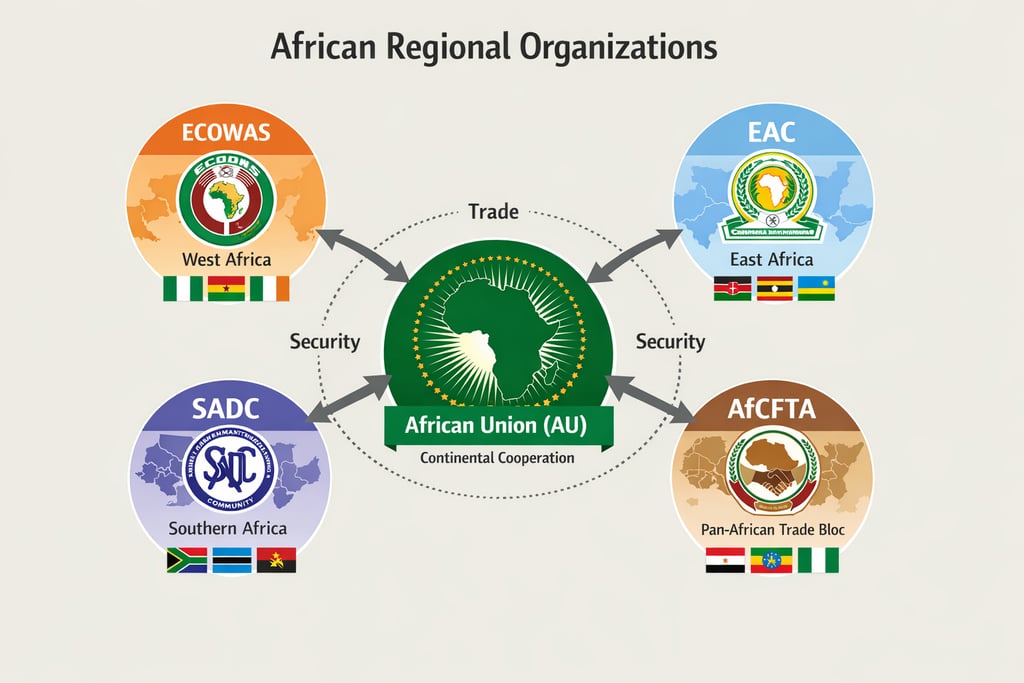
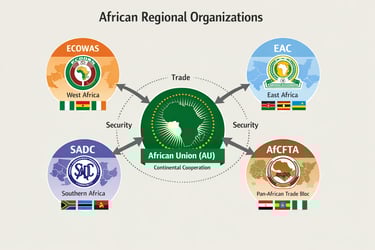
Several major regional institutions shape policy across the continent.
African Union (AU)
The African Union coordinates continental policies, peacekeeping missions, and development initiatives.
ECOWAS
The Economic Community of West African States focuses on trade integration and regional security.
East African Community
The EAC aims to build a single market and eventually a common currency for member states.
SADC
The Southern African Development Community promotes infrastructure development and regional investment.
These organizations allow smaller countries to gain influence through collective policy making.
What Mistakes Do People Commonly Make When Learning About African Countries?
Many people misunderstand Africa by treating the continent as a single country or assuming all nations share similar cultures and economic conditions.
Africa’s diversity is often underestimated.
A common mistake is assuming economic conditions are uniform across the continent.
In reality:
Mauritius has one of Africa’s highest GDP per capita levels.
Somalia faces long-term governance challenges.
Rwanda has built one of the continent’s fastest improving business environments.
Another misconception involves cultural identity.
African countries contain hundreds of ethnic groups with distinct traditions, languages, and social structures.
Treating Africa as a single homogeneous region oversimplifies its political and economic complexity.
How Can Travelers and Investors Evaluate African Countries?
Travelers and investors should analyze safety, infrastructure, political stability, economic growth, and regulatory frameworks before engaging with any African country.
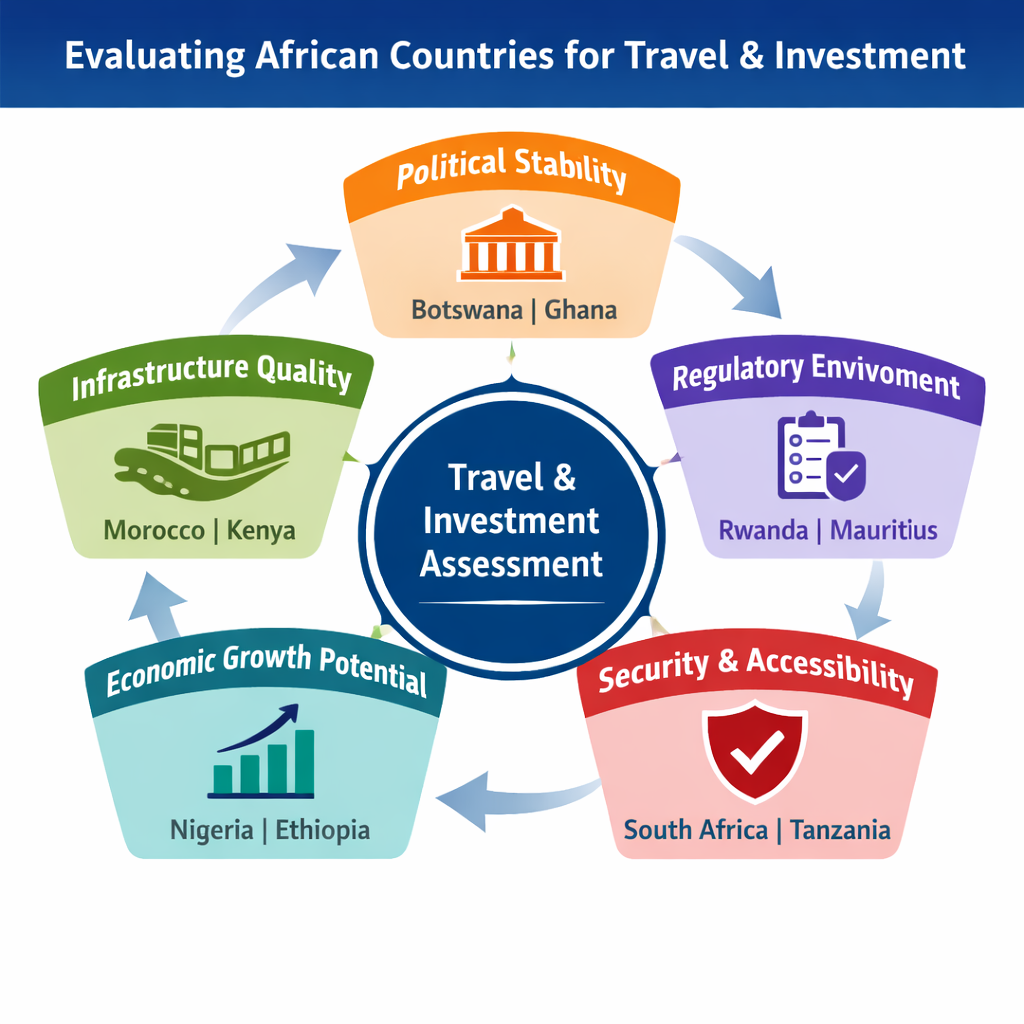
Africa’s countries differ widely in landscapes, travel logistics, and cultural norms. Before planning a trip, it helps to understand how each nation fits within its region and what conditions travelers should expect.
If you want a practical overview of visas, transportation, safety considerations, and destination planning across the continent, you can also explore our Travel Guide to Africa, which explains how these regional differences affect real travel decisions.
For travelers, key considerations include:
visa requirements
transportation infrastructure
tourism infrastructure
regional security conditions
Countries such as Kenya, Tanzania, Morocco, and South Africa are well established tourism destinations.
Investors often evaluate additional factors.
These include:
regulatory transparency
corruption risk
currency stability
ease of doing business
Countries like Rwanda, Botswana, and Mauritius are frequently cited for investor friendly policies.
Analyzing each country individually is essential because conditions vary widely across the continent.
Frequently Asked Questions
How many countries are in Africa?
Africa has 54 internationally recognized countries. These nations are members of the United Nations and most also belong to the African Union.
Which is the largest country in Africa?
Algeria is the largest African country by land area. It covers more than 2.3 million square kilometers.
Which African country has the largest population?
Nigeria is Africa’s most populous country, with more than 220 million people.
What is the richest country in Africa?
Measured by GDP per capita, Seychelles and Mauritius often rank among the richest African countries. South Africa and Nigeria have the largest total economies.
Which African country is best for tourism?
Popular tourism destinations include Kenya, Tanzania, Morocco, South Africa, and Egypt due to their wildlife reserves, cultural heritage sites, and established travel infrastructure.
Africa’s countries represent one of the most dynamic regions in the world. Understanding their geography, economies, and cultures reveals a continent shaped by diversity, resilience, and growing global influence.
About The Author
Mubashir Shakoor Godha is a blogger, digital marketer, and SEO specialist based in Pakistan. He started his journey in 2019 on Blogger.com and has since built and managed multiple websites that rank on Google and AI driven search platforms.
He is also the Founder of MSG Digitals, Top Rated Digital Marketing Agency in Pakistan, where he helps businesses grow through SEO, content strategy, and performance marketing.

usefulservices24@gmail.com
© 2026 Tales of Africa. All rights reserved.